The best bitrate for streaming depends on your resolution, frame rate and platform: roughly 3,000–6,000 kbps for 1080p, 4,500–6,000 kbps for 1080p60, and 2,500–4,000 kbps for 720p. Twitch caps most streamers around 6,000 kbps; YouTube allows higher. Higher bitrate means better quality but needs more upload bandwidth — a good rule is to use no more than about 50–75% of your upload speed, so the stream stays stable.
What is bitrate in streaming?
Bitrate is how much data your stream sends per second, measured in kilobits per second (kbps). More bitrate carries more detail — sharper image, cleaner motion — but demands more upload bandwidth. Get it wrong in either direction and you either waste bandwidth or get a blocky, buffering stream. (For audio specifically, see our audio bitrate guide.)
Recommended bitrate for streaming, by resolution
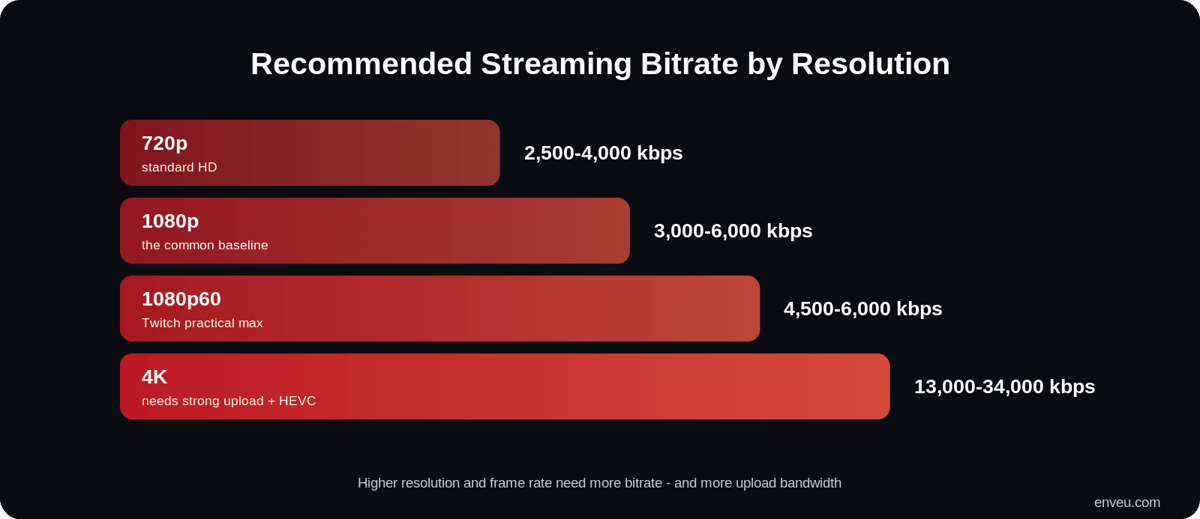
| Resolution | Recommended video bitrate | Notes |
|---|---|---|
| 720p30 | 2,500–4,000 kbps | Good for limited upload |
| 720p60 | 3,500–5,000 kbps | Smoother motion |
| 1080p30 | 3,000–6,000 kbps | The common baseline |
| 1080p60 | 4,500–6,000 kbps | Twitch practical max |
| 4K | 13,000–34,000 kbps | Needs strong upload + HEVC |
Twitch bitrate limits
Twitch recommends staying at or below 6,000 kbps for most streamers — pushing higher risks buffering for viewers because Twitch prioritizes stability. So on Twitch, 1080p60 at ~6,000 kbps is the practical ceiling. YouTube and other platforms allow higher bitrates, which is why 4K streaming is more common there.
How to choose your bitrate
- Check your upload speed — run a speed test; use roughly 50–75% of your upload for the stream.
- Match resolution + frame rate — higher resolution and 60fps need more bitrate.
- Prioritize stability — a stable 1080p at 4,500 kbps beats a stuttering 1080p at 8,000.
- Codec matters — HEVC delivers the same quality at a lower bitrate than H.264, useful for 4K.
Recommended bitrate by platform
Each platform sets its own ceilings and defaults, so the "best" bitrate shifts with where you stream:
| Platform | Practical bitrate | Note |
|---|---|---|
| Twitch | Up to ~6,000 kbps | Prioritizes stability; 1080p60 is the ceiling |
| YouTube | Up to ~51,000 kbps (4K60) | Allows much higher; supports 4K |
| Facebook Live | ~4,000 kbps (1080p) | Conservative caps for reliability |
| Your own OTT app | You set it (ABR ladder) | Serve multiple bitrates, no single cap |
Audio bitrate for streaming
Don't forget the audio track — it's part of your total bitrate. For most live streaming, 128–160 kbps AAC stereo is the sweet spot: clear sound without eating into your video budget. Music-heavy streams can push to 256–320 kbps. Add this to your video bitrate when checking it fits your upload. See our audio bitrate guide for detail.
Bitrate vs bandwidth: what's the difference?
They're easy to confuse. Bitrate is how much data your stream produces per second; bandwidth is how much data your connection can carry per second. Your bitrate must fit comfortably inside your upload bandwidth (not download) — and inside your viewers' download bandwidth. If your bitrate is higher than the available bandwidth at either end, the stream buffers. That's why the 50–75%-of-upload rule matters: it leaves headroom for the inevitable dips.
CBR vs VBR for streaming
For live streaming, use CBR (constant bitrate) — it keeps a steady data rate that platforms and viewers' connections handle predictably. VBR (variable bitrate) can save space for recording but risks spikes that destabilize a live stream. Most streaming guides and encoders default to CBR for live — see our full CBR vs VBR guide for when to pick each.
Common bitrate problems and how to fix them
| Problem | Likely cause | Fix |
|---|---|---|
| Dropped frames / buffering | Bitrate too high for your upload | Lower the bitrate, or use ~50–75% of upload |
| Blocky, pixelated video | Bitrate too low for the resolution | Raise bitrate or drop to a lower resolution |
| Stutter on motion | 60fps at too low a bitrate | Increase bitrate or switch to 30fps |
| Unstable / spiky stream | VBR on a live encode | Switch the encoder to CBR |
Tips to improve your streaming bitrate
- Use a wired connection — ethernet is far more stable than Wi-Fi for a sustained upload.
- Tune your streaming software — set CBR, pick the right keyframe interval (2s), and match the encoder preset to your CPU/GPU.
- Use capable hardware or a dedicated encoder — encoding on the same machine you're gaming on steals resources; a hardware encoder avoids that.
- Adjust bitrate to your real upload — test, don't guess; back off if you see dropped frames.
Does higher bitrate always mean better quality?
No — bitrate has diminishing returns. Beyond the point your resolution, codec and source can use, extra bitrate just wastes bandwidth without a visible improvement, while risking buffering for viewers. A well-encoded 1080p at 6,000 kbps looks better than a poorly configured one at 10,000. Codec matters more than raw numbers: HEVC or AV1 deliver the same quality as H.264 at a much lower bitrate, so upgrading the codec often beats cranking the bitrate.
Bitrate for recording vs live streaming
The rules differ. For recording (a local master you'll edit later), use a high bitrate and VBR to preserve quality — bandwidth isn't a constraint. For live streaming, use CBR and a bitrate your upload can hold, because stability beats peak quality when it's going out in real time. If you record and stream at once, prioritize the live settings and keep a separate high-quality local recording if your encoder supports it.
How to test your streaming bitrate
Before going live, run a test stream and watch for dropped frames in your encoder's stats. On Twitch, the Twitch Inspector tool analyses a test stream and flags instability, bitrate spikes and dropped data — so you can dial in a stable bitrate before a real broadcast. Most platforms and encoders expose similar health stats; the goal is zero dropped frames at your chosen bitrate.
Let the platform handle bitrate with adaptive streaming
Picking one bitrate is a compromise — some viewers have fast connections, others slow. The professional answer is adaptive bitrate (ABR): deliver several renditions and let each viewer's player pick. Enveu's live streaming platform ingests your encoder feed (RTMP/SRT) and automatically transcodes it to adaptive bitrate up to 4K, so every viewer gets the best quality their connection allows — you don't have to choose one bitrate for everyone. See also streaming resolutions and hardware encoders.