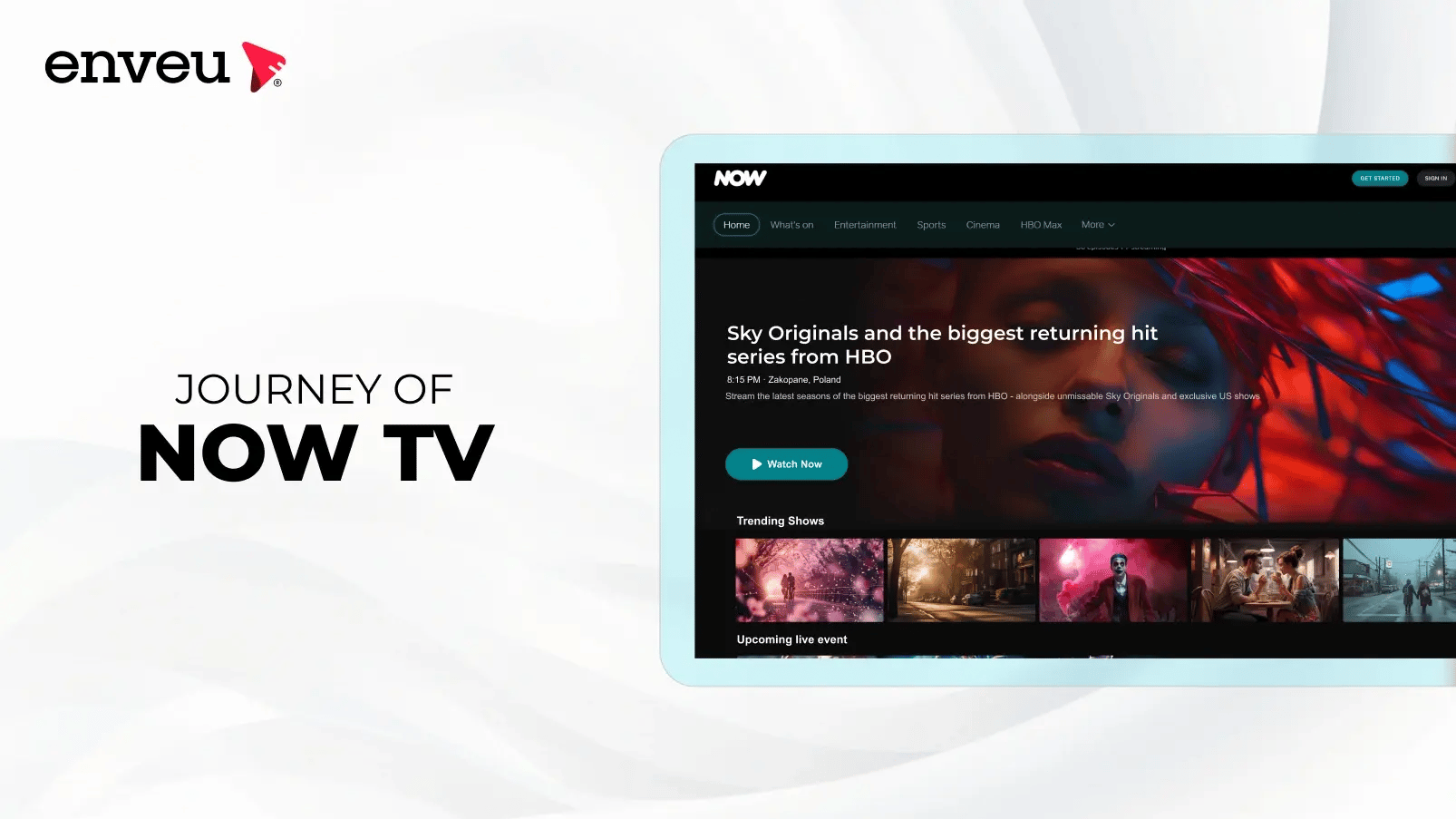
Long before "flexible, contract-free streaming" was a marketing cliché, one service in the UK built its whole identity around it. NOW — the streaming service you may still know as NOW TV — let people watch Sky's premium content without a satellite dish or a long contract, paying month to month for exactly the passes they wanted. It's a case study in how an incumbent broadcaster can launch a nimble direct-to-consumer product, and it holds real lessons for anyone building an OTT service today. Here's what NOW TV is, who owns it, how it works, and what makes its model worth studying.
NOW TV — rebranded simply as NOW in 2021 — is a contract-free, over-the-top streaming service from Sky, the European broadcaster owned by Comcast. Launched in the UK in 2012, it sells flexible monthly Memberships (formerly "Passes") for Entertainment, Cinema, Sports, Kids and hayu, streaming Sky content to any device — no satellite dish, no long-term contract.
What is NOW TV?
NOW TV is an over-the-top (OTT) streaming service that delivers Sky's television content — movies, entertainment, live sports and kids' programming — over the internet, to any connected device. It was created as Sky's answer to Netflix and Amazon Prime Video: a way to reach the large audience of people who wanted Sky's shows and sport but didn't want a satellite subscription, a dish on the wall, or a multi-year contract. Instead of one big bundle, NOW sells its content as separate Memberships (originally called Passes) that customers can pick and mix, turn on for a month, and cancel any time. In 2021 the service dropped "TV" from its name and rebranded to simply NOW, though many people still search for and refer to it as NOW TV.
Who owns NOW TV?
NOW is owned by Sky, and Sky in turn is owned by the American media giant Comcast, which acquired Sky in 2018. So the ownership chain is: NOW → Sky → Comcast. This matters because it explains where NOW's content and technology come from — it's backed by Sky's programming rights (including Sky Cinema, Sky Sports and Sky's entertainment channels) and by Comcast's global streaming resources. In fact, NOW is moving onto NBCUniversal's Global Streaming Platform, the same underlying technology that powers Peacock in the US and SkyShowtime in Europe — a sign of how Comcast is consolidating its streaming products onto shared infrastructure. NOW is not an independent company; it's the flexible, contract-free front door to Sky's content, operated within the Comcast group.
When did NOW TV launch, and how has it expanded?
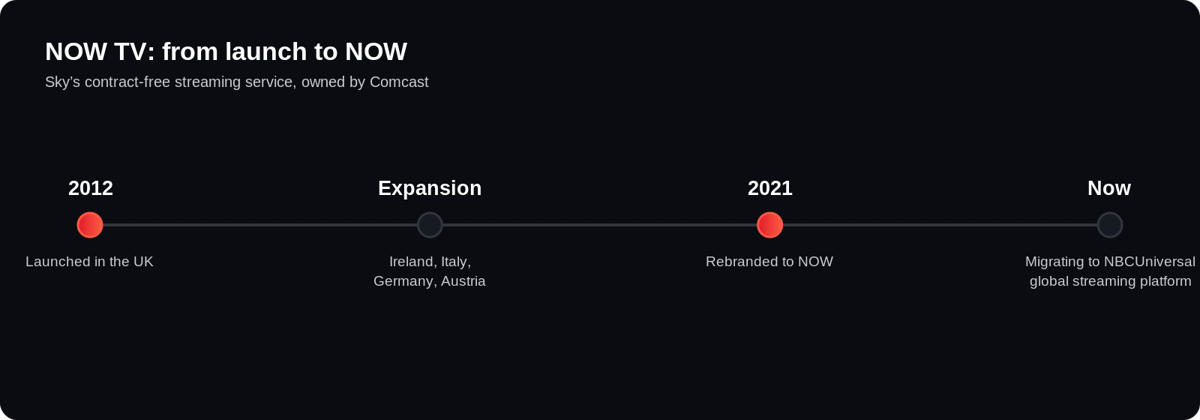
NOW TV launched in the UK in 2012, initially built around movies and soon expanding to entertainment and sport. Its pitch was simple and, at the time, novel: get Sky's premium content without a Sky subscription. Over the following years it expanded internationally, reaching markets including the Republic of Ireland, Italy, Germany and Austria, adapting its passes to local content and sport. In early 2021 the service rebranded from NOW TV to NOW, reflecting that "TV" no longer captured a service watched on phones, laptops and smart TVs as much as on a television. By that period it had grown into a major streaming brand in its markets — reaching millions of households and establishing itself as a significant asset in Sky's direct-to-consumer strategy. Its continued migration onto Comcast's shared global streaming platform is the latest chapter: a move to run NOW on the same modern infrastructure as its sister services.
How does NOW TV work?
NOW works on a simple, flexible model. Instead of one all-in subscription, you choose one or more Memberships, each covering a slice of Sky's content, and pay monthly with no contract — start, stop and switch whenever you like. You stream over the internet through the NOW app, which runs on a wide range of devices: streaming sticks and boxes, games consoles, smart TVs, phones, tablets and computers. There's no dish and no installation. Because it's contract-free, a customer can, say, take the Sports Membership only for the months a season is running, then drop it — a flexibility a traditional pay-TV contract doesn't allow. That combination of premium content plus pay-only-for-what-you-want is the heart of how NOW works and why it carved out a distinct place next to Netflix and Prime Video.
NOW TV Memberships and Boost: how many devices ("seats") can you stream?
A very common question is how many people can watch NOW at once — often phrased as how many "seats" NOW TV has. By default, NOW allows a limited number of simultaneous streams, and you increase quality and concurrency with the Boost add-on. Boost adds Full 1080p HD, Dolby surround sound, and the ability to stream on more devices at the same time. Historically Boost enabled three simultaneous streams; NOW has since revised its tiers, with the standard Boost add-on covering fewer concurrent streams and a higher "Ultra Boost" tier for the maximum. The exact numbers and prices change over time, so the current NOW site is the authority — but the model is consistent: a base Membership for standard viewing, and a paid Boost tier for higher quality and more simultaneous screens. The table summarises NOW's structure.
| Element | What it covers |
|---|---|
| Entertainment Membership | Sky's entertainment channels and box sets |
| Cinema Membership | Sky Cinema movies |
| Sports Membership | Sky Sports — available on flexible day/month terms |
| Kids Membership | Children's shows and films |
| hayu | Dedicated reality-TV content |
| Boost add-on | 1080p HD, surround sound, and more simultaneous streams |
Where NOW TV wins: the model behind it
What set NOW apart from Netflix and Prime Video wasn't just its content — it was the packaging. By splitting Sky's catalogue into separate, contract-free Memberships, NOW let customers buy exactly the slice they valued: a film lover could take Cinema, a fan could take Sports for a single season, a household could add Kids. That flexibility made NOW a complement to other subscriptions rather than an either/or choice — you could keep Netflix for series and use NOW's Cinema pass for the latest films. Combined with broad device support and no lock-in, it turned Sky's premium, exclusive content into something people could dip into on their own terms. It's a textbook example of using flexible monetization to widen a premium broadcaster's reach without cannibalising its core subscription business. It also lowered the barrier to entry: a curious viewer could try a single month of one Membership for the price of a couple of coffees, discover the content, and often stay — turning flexibility into a low-risk acquisition funnel rather than a discount. That psychology, as much as the technology, is what made the model durable.
What OTT operators can learn from NOW TV
NOW's story maps directly onto the choices every OTT operator faces today. The first lesson is flexible monetization: NOW's contract-free, pick-your-passes model shows the value of supporting multiple plans and entitlements — subscription, add-ons, day passes — rather than a single tier. A modern video monetization platform makes that kind of packaging configurable instead of a rebuild. The second is reach across every screen: NOW's device breadth is what makes "watch anywhere" real, the same reason multi-device support is now table stakes. The third is owning the direct-to-consumer relationship: NOW let Sky reach cord-cutters directly, which is exactly what a white-label streaming platform enables for any broadcaster or rights-holder — your brand, your apps, your data. You don't need Sky's scale to apply the playbook: the same building blocks power entertainment and sports streaming services of every size, and services like Amazon Prime Video monetize on similar principles. NOW TV simply got there early — and made flexibility its signature.