To sell video content online, put it behind one of four models — subscription (SVOD), rent-or-buy (TVOD), pay-per-view (PPV) for live, or ad-supported (AVOD) — on a platform that gives you your own branded store and apps. The best platform depends on what you sell: creators and course sellers favour tools like Uscreen or Kajabi, while broadcasters and scaling operators use a white-label OTT platform to own the apps, the audience and the revenue.
Why sell video content online?
Video is one of the few content types people happily pay for directly, and the tools to charge for it are now within reach of any creator or business. Three reasons it's worth doing: revenue potential — subscriptions, rentals and pay-per-view turn an audience into recurring income; ownership and branding — on your own platform you keep the customer relationship, the data and the brand, instead of being one clip in someone else's feed; and demand for niche content — audiences increasingly seek out specialist libraries (a fitness style, a sport, a genre, a course) that the big free platforms don't serve well. If you have video people value, selling it directly is often more durable than chasing ad pennies.
What is a video-on-demand (VOD) platform?
Most people selling video online end up on a video-on-demand (VOD) platform — software that hosts your library, puts it behind a paywall, and streams it to viewers on any device, on their schedule. It handles the parts you don't want to build: storage and a content library, transcoding for every connection, secure payments and paywalls, apps across web/mobile/TV, and analytics. Whether you sell one course or run a full streaming service, the VOD platform is the storefront and the delivery engine underneath it. The best VOD platforms let you keep your own brand and — ideally — your full revenue.
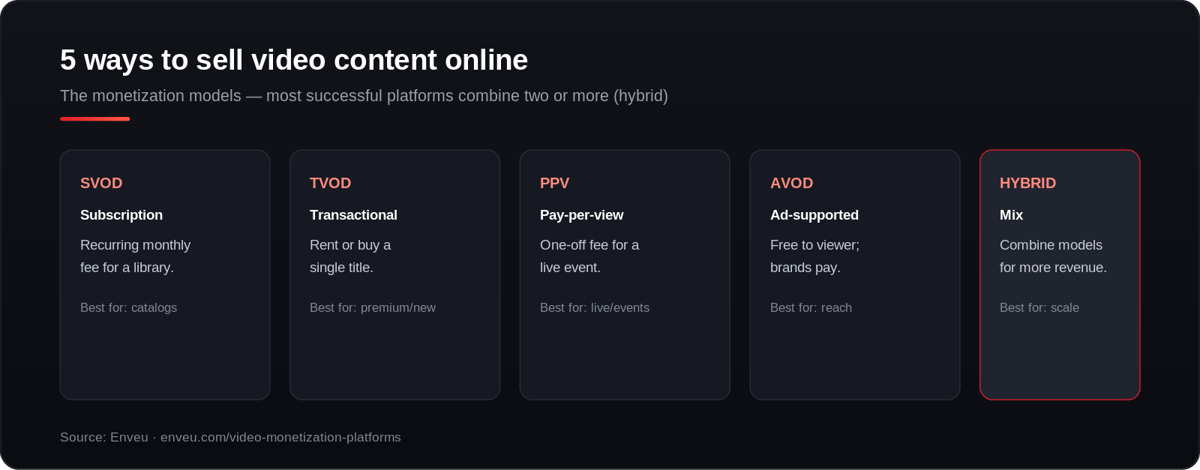
How to sell video content online: the 5 models
| Model | How viewers pay | Best for |
|---|---|---|
| SVOD (subscription) | Recurring fee for library access | Catalogs & steady recurring revenue |
| TVOD (transactional) | Rent or buy individual titles | Premium titles & new releases |
| PPV (pay-per-view) | One-off charge for a live event | Sports, concerts, webinars |
| AVOD (ad-supported) | Free — brands pay for the ads | Maximising reach & audience |
| Hybrid | A mix (e.g. subscription + rentals) | Capturing the most revenue per viewer |
Best platforms to sell video content online (compared)
The right choice depends on whether you're a creator, a course seller, or a media business that needs its own branded apps. Pricing changes often — check each vendor's current plans — but here's how the main options line up.
| Platform | Models | Own branded apps (TV/mobile) | Revenue model | Best for |
|---|---|---|---|---|
| Enveu | SVOD, AVOD, TVOD, PPV, hybrid | Yes — 15+ platforms, fully white-label | 0% revenue share (licence) | Broadcasters & scaling operators |
| Uscreen | SVOD, TVOD | Yes (apps add-on) | Monthly fee | Creators & membership sites |
| Vimeo OTT | SVOD, TVOD | Yes | Monthly fee | Creators launching OTT |
| Muvi | SVOD, AVOD, TVOD, PPV | Yes | Monthly fee | DIY multi-model |
| Dacast | TVOD, PPV, live | Limited | Monthly + bandwidth | Live streaming & events |
| Kajabi | Subscriptions / courses | No (course site) | Monthly fee | Course creators |
How to sell your video content online, step by step
- Pick your model — SVOD, TVOD, PPV, AVOD, or a hybrid, based on your content and audience.
- Choose a platform — one that supports your model and gives you your own branded storefront and apps.
- Upload & organise your catalog with good metadata, thumbnails and categories.
- Set pricing and paywalls — plans, rentals or event tickets, with secure payments.
- Publish across devices — web, mobile and TV — and market to your audience.
- Protect & measure — add DRM for premium content and track what sells.
Key features to look for in a video-selling platform
- Multiple monetization models — SVOD, AVOD, TVOD and PPV, so you're not locked into one way to earn.
- DRM & security — encryption and studio-grade DRM to stop your paid content being copied or shared.
- White-label branding — your name, look and domain, not the vendor's.
- Multi-device delivery — web, mobile, and TV apps (Apple TV, Fire TV, Roku, Android TV).
- Analytics & insights — what sells, who watches, where they drop off.
- Scalability & hosting — adaptive-bitrate delivery that holds up as your audience grows.
- Payment flexibility — the gateways and currencies your buyers actually use.
What kinds of video can you sell online?
Almost any format monetizes with the right model. Online courses & tutorials sell well as subscriptions or one-off purchases; films, series and documentaries suit rentals, purchases or a subscription catalog; live events (sports, concerts, workshops) fit pay-per-view; fitness and wellness classes thrive on memberships; and niche or community content often does best behind a subscription. The model follows the content and the audience — which is why a platform that supports all of them keeps your options open.
Where can you sell videos online: your platform vs marketplaces
There are two broad routes. Marketplaces (YouTube, Vimeo on Demand, Patreon, course marketplaces) give you instant reach but take a cut, cap your pricing and branding, and own the customer. Your own platform (a white-label VOD/OTT service) takes a little more to set up but keeps 100% of the relationship — your brand, your pricing, your data, your apps. Many sellers start on a marketplace for discovery and move their core, paying audience onto their own platform as they grow, so the recurring revenue isn't at the mercy of a third party's rules.
Can you sell videos online for cash?
Yes — the whole point of these models is turning views into revenue. Creators earn through subscriptions, rentals, pay-per-view tickets and ad revenue; the difference between "a bit of pocket money" and a real income is usually owning your platform instead of renting an audience on someone else's, where a cut of every sale disappears and you don't control pricing or the customer relationship.
How much does it cost to sell video online?
Platform pricing comes in three shapes, and the difference matters at scale. Monthly subscription fees (most creator tools) are predictable but rise with usage. Revenue-share models take a percentage of every sale — cheap to start, expensive once you're successful. Licence/flat pricing (how Enveu works) means you pay for the platform and keep 0% revenue share — so as your sales grow, your platform cost doesn't eat into them. On top of the platform, budget for payment-processing fees and, if you carry premium content, DRM. The right model depends on your volume: revenue-share can suit tiny catalogs, but anyone selling seriously usually comes out ahead owning the platform.
How to choose the right platform
If you're an individual creator or selling courses, an all-in-one creator tool is the fastest start. But if you're building a real media business — your own brand, your own TV/mobile apps, and you don't want to hand over a slice of every sale — a white-label OTT platform is the better fit. The two questions that decide it: do you need native apps on every screen, and do you want to keep 100% of your revenue?
Sell video content on your own platform, with 0% revenue share
With Enveu, you sell video content through every model — SVOD, TVOD, PPV, AVOD and hybrid — from your own branded store and apps across TV, mobile and web, and you keep 100% of your revenue with 0% revenue share. Add DRM for premium titles, and scale from a single catalog to a full OTT service.
See the full picture in Experience Cloud, explore white-label streaming, or learn how to make a movie streaming app.