Twitch turned live streaming from a niche into a culture — over 240 million monthly active users now watch and, crucially, interact in real time. That success has a lot of teams asking the same question: how do you build a live streaming website like Twitch? The honest answer is that it's less about copying features and more about getting the architecture, streaming pipeline and scaling strategy right from day one. This guide walks through the core features users expect, the tech stack behind a Twitch-style platform, and the build-vs-buy decision that shapes everything. Behind the scenes, media workflow automation handles the repetitive work — live-to-VOD, clipping and captioning — with no editor in the loop.
To build a live streaming website like Twitch you need seven core pieces: user accounts, live video ingest with adaptive delivery, real-time chat, profiles, a follow/subscribe system, VOD recording, and monetization. Under the hood that means RTMP or WebRTC ingest, transcoding to HLS/DASH, a CDN, a scalable real-time chat service and a cloud back end — built yourself, or provided by a ready-made streaming platform.
What features does a Twitch-like platform need?
Before any architecture decision, it helps to know what users actually expect. Twitch's real insight was that viewers want interaction, not just video — so the feature set is as much about community as playback.
| Feature | What it does |
|---|---|
| User authentication | Registration/login with token-based auth (JWT), OAuth (Google/Facebook), and role-based access for streamers, viewers, moderators and admins |
| Live streaming | Start a stream with title/category/tags; encode to multiple bitrates; deliver via CDN; DVR-style pause/rewind |
| Real-time chat | Instant messaging at scale with moderation (mute, delete, ban), anti-spam and rate limiting |
| User profiles | Bio, avatar, follower count and recent activity — identity that builds trust |
| Follow & subscribe | Go-live notifications for followers; paid subscriptions with perks and badges |
| VOD recording | Auto-record live streams into on-demand content, with tagging and search |
| Monetization | Ads, subscriptions, donations/tips, pay-per-view events and sponsorships |
How is a live streaming platform architected?
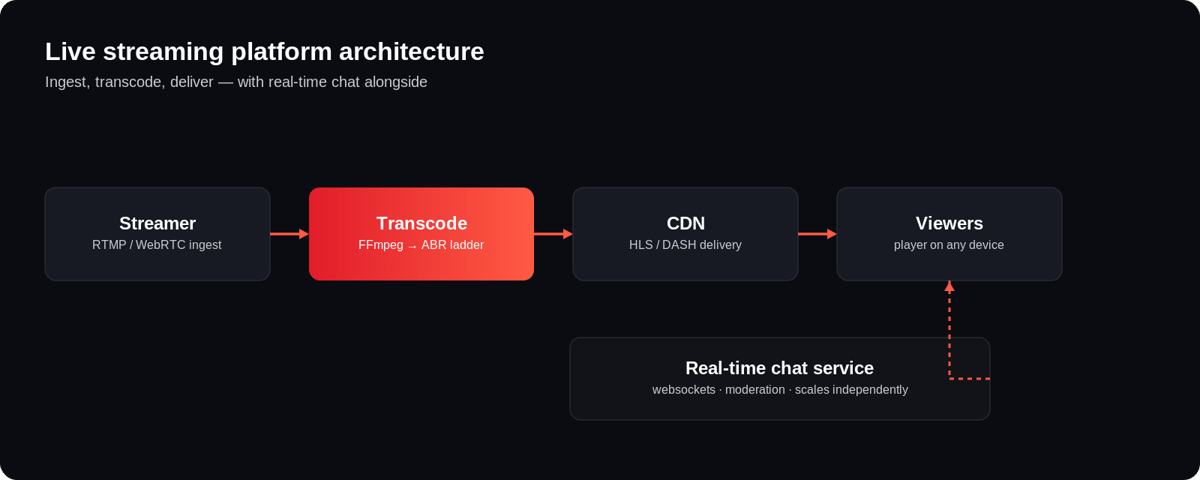
A live platform is best built as a modular, service-based system so it can scale without breaking. The frontend handles user interaction — typically a modern web framework (React, Vue or Angular) plus mobile apps (React Native or Flutter), and smart-TV apps later for reach. The backend manages logic and data through an API gateway that routes requests, sitting in front of microservices that each own one responsibility: authentication, streaming, chat, notifications and profiles. Separating these means the chat service can scale independently of the streaming service, and a change to one doesn't risk the others — essential when a single popular streamer can bring thousands of concurrent users in seconds.
What tech stack does Twitch use?
People often search for "Twitch tech stack" or "Twitch architecture" — the reality is a mix chosen for real-time performance at scale. Twitch's own engineering has described using Go, Python, C++ and some Rust, with Go's concurrency model well-suited to chat and messaging. Here's the stack most Twitch-style builds use.
| Layer | Common choices |
|---|---|
| Frontend | React / Vue / Angular; React Native or Flutter for mobile |
| Backend | Node.js/Express or Python/Django to start; Go for real-time chat and messaging |
| Streaming | RTMP/WebRTC ingest, NGINX-RTMP media server, FFmpeg transcoding, HLS/DASH delivery over CDN |
| Cloud (AWS example) | EC2 compute, S3 for VOD storage, RDS/DynamoDB, AWS IVS/Media Services, SNS/SQS, CloudWatch/Kinesis |
Which streaming protocol should you use?
The protocol choice is the heart of a live platform, and it's a trade-off between latency and scale.
| Protocol | Best for | Trade-off |
|---|---|---|
| RTMP | Ingesting the stream from the broadcaster's encoder | Great for ingest; not used for modern playback |
| WebRTC | Sub-second, interactive latency (e.g. live auctions, co-streaming) | Harder to scale to huge audiences |
| HLS / DASH | Scalable delivery to massive audiences via CDN | Higher latency (a few seconds) than WebRTC |
Most Twitch-style platforms ingest with RTMP, transcode with FFmpeg, and deliver with HLS/DASH over a CDN for scale — reserving WebRTC for features that genuinely need real-time interaction. See our guide to streaming protocols for the detail.
How do you scale a live streaming website?
Live platforms face unpredictable spikes — a popular streamer can bring thousands of viewers instantly — so scaling has to be designed in, not bolted on. Horizontal scaling absorbs surges by adding instances; load balancers distribute traffic evenly; caching reduces database pressure; and high-volume platforms use database sharding to manage growth. The CDN is critical — it offloads delivery from core servers and keeps latency low worldwide. The guiding principle is to design for failure: assume components will fail under load and build in redundancy and fast recovery so a traffic spike degrades gracefully instead of taking the platform down.
A realistic development roadmap
Building everything at once rarely works. Start by validating user needs with an MVP focused on the essentials — core live streaming, chat and basic profiles — and prototype the UI/UX to test ideas early. Use beta testing under simulated peak load to expose weak points before real users hit them, then do a soft launch to gather real-world data. Influencer collaborations can accelerate early adoption, and continuous updates driven by analytics keep the platform relevant. The mistake to avoid is over-building features nobody has validated while under-investing in the streaming and chat infrastructure that determines whether the product actually works at scale.
How much does it cost to build a platform like Twitch?
There's no single figure — it depends entirely on the build-vs-buy choice. A from-scratch build means a multidisciplinary engineering team (frontend, backend, streaming, DevOps) working for months to a year or more, plus ongoing cloud bills that scale with viewers and continuous maintenance as platforms and devices change — easily a six-figure-plus commitment before launch. A platform-based build turns most of that capital cost into a predictable subscription and cuts time-to-launch from quarters to weeks, because the streaming and monetization infrastructure already exists. The other cost to plan for is bandwidth and delivery: live video at scale is expensive to serve, so CDN efficiency and adaptive bitrate matter as much to your margins as to the viewer experience. Whichever route you choose, budget for the ongoing cost of running live infrastructure, not just building it — and consider whether related live formats like IRL streaming belong on your roadmap.
Build it yourself, or use a platform?
Here's the decision that shapes everything. Building a Twitch-like platform from scratch means engineering — and then maintaining — ingest, transcoding, a CDN integration, real-time chat at scale, DRM, apps for every device, and a cloud back end that survives traffic spikes. That's a large, ongoing engineering programme, and most of it is undifferentiated plumbing rather than your actual product. The alternative is to build on a platform that provides the streaming backbone so your team focuses on the experience and community. Enveu's live streaming platform handles RTMP/SRT ingest, adaptive-bitrate transcoding, multi-DRM, CDN delivery and monetization (subscriptions, ads, tips, pay-per-view), with branded apps across web, mobile and TV from one back end — part of a white-label platform that's yours end to end. Custom builds pay off for organisations with highly unusual requirements and the engineering budget to sustain them; for everyone else, starting on a platform is faster, cheaper and far lower-risk — and you can still layer your own chat, community and UI on top.