You poured months into a short film. Festivals are great for prestige, but they rarely pay the bills — so the real question is how to turn that work into income you can reinvest in the next project. The good news: short films absolutely can make money, through more channels than most filmmakers realise. Here's exactly how.
You make money from short films by combining several revenue streams: film-festival prizes, YouTube ad revenue, licensing and distribution deals, your own pay-per-view or subscription platform, crowdfunding, brand sponsorships, and merchandise. No single channel makes a short film profitable on its own — the filmmakers who earn well stack two or three, and increasingly host and sell the film directly to keep more of the revenue.
Do short films actually make money?
Yes — but rarely from a single big payout. A short film's value is spread across direct income (prizes, ad revenue, sales and rentals) and indirect value (it's your calling card — proof of concept that wins commissions, clients and collaborators). Treat the film like a small business with multiple income lines, not a lottery ticket, and it can both recover its costs and fund what comes next. The filmmakers who "make money from short films" are the ones who plan monetization before the film is finished, not after.
How to make money from short films: the main ways
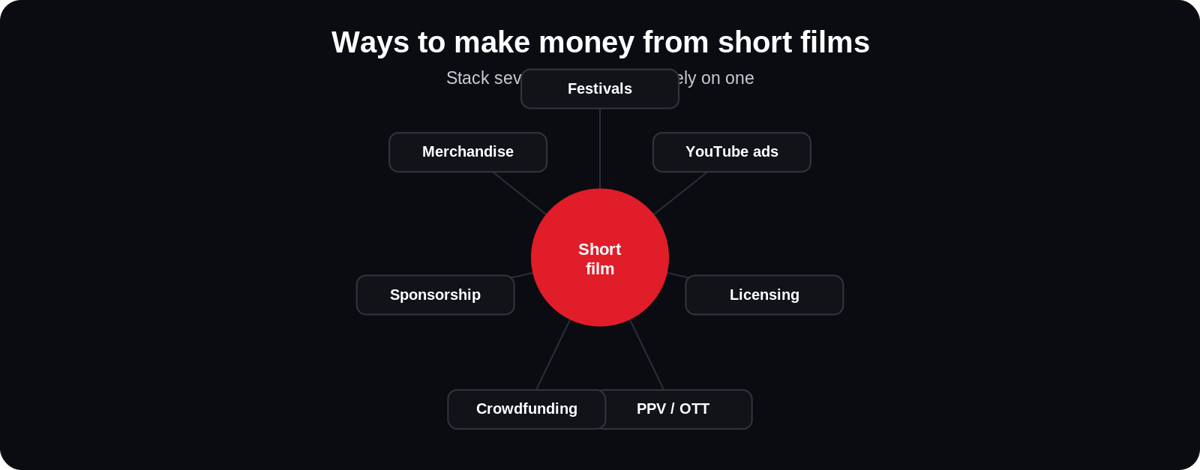
| Revenue stream | How it works |
|---|---|
| Film festivals & awards | Cash prizes plus exposure, credibility and industry contacts that lead to paid work |
| YouTube / ad revenue | Monetize views with ads once you hit the eligibility threshold; steady, if modest, per-view income |
| Licensing & distribution | Sell or license the film to streamers, broadcasters, airlines or educational distributors |
| Your own OTT / pay-per-view | Host the film on your own branded app and charge to rent or buy — you keep most of the revenue |
| Crowdfunding | Fund production up front (Kickstarter/Patreon-style) and build a paying community around your work |
| Sponsorships & brand deals | Brand-funded shorts or in-film placement — a natural fit for a strong, on-brand story |
| Merchandise & community | Posters, BTS content, memberships — monetize a loyal audience directly |
The strongest approach combines a few: a festival run for credibility, YouTube for reach, and a pay-per-view release for direct income from the fans who want to watch in full.
How to sell a short film
Selling a short film means getting paid for access to it, and there are three routes. License it to a distributor, streaming service or broadcaster, who pays a fee (flat or revenue-share) for the rights. Enter distribution marketplaces that place shorts with buyers such as airlines, hotels and educational platforms. Or sell it directly from your own platform — rentals, one-off purchases or bundles — cutting out the middleman entirely. Direct sales pay the most per view but require you to bring the audience; licensing pays less per view but hands you distribution and reach. Many filmmakers do both: license for reach, sell direct to superfans.
Where to distribute and sell your short film
Distribution is where earning actually happens, and you have four broad homes for a short. Film festivals build prestige and can pay cash prizes, but they're a marketing channel more than a revenue one. YouTube and social platforms give mass reach and ad revenue, at the cost of low per-view pay and platform control. Short-film marketplaces and distributors place your film with buyers — streamers, airlines, educators — for a licensing fee or revenue share. And your own branded platform lets you sell rentals and purchases directly, typically as transactional video (TVOD) or pay-per-view. The smart play is to sequence them: festivals and YouTube first for exposure, then a paid release (licensed and/or direct) to convert that attention into income. If your work is vertical or episodic, a short-drama app model can turn a catalog of shorts into a recurring business.
Festivals vs online: which makes more money?
| Festivals | Online (YouTube / licensing) | Your own platform | |
|---|---|---|---|
| Pays | Occasional cash prizes | Low per view, adds up over time | Highest per view |
| Reach | Niche, curated | Mass | Your audience only |
| Best for | Prestige & contacts | Exposure & steady income | Superfans & owning the revenue |
| You keep | Prize, minus entry fees | A share after platform cut | Most of it (0% revenue share) |
It depends on your goal. Festivals occasionally pay meaningful prize money and are unbeatable for credibility, contacts and press — but most films don't win, and the payout is one-off. Online monetization (YouTube, licensing, direct sales) pays less per view but compounds: a film keeps earning ad revenue, rentals and licensing fees for years, and grows an audience you can sell future work to. For a single prestige piece, lean festivals. For a body of work you want to earn from continuously, lean online — especially a platform you own, where you keep the revenue and the audience relationship instead of handing both to a third party.
Turn views into revenue with your own platform
The channel filmmakers most often overlook is owning the audience relationship. Instead of surrendering most of the revenue to a marketplace, you can host your films on your own branded streaming app and monetize them directly. On Enveu's video monetization platform you can set up pay-per-view, rentals, subscriptions or a hybrid, with a branded landing page and player, DRM to prevent piracy, global multi-currency payments, and analytics on watch time and revenue — with 0% revenue share beyond standard fees. It's ideal for a slate of shorts, a short-form short-video service, or a film-festival-style catalog you own end to end.
How much can a short film make?
There's no single figure — earnings range from almost nothing to a meaningful side income, depending on the film and how hard you work the channels. A festival prize might be a few hundred to a few thousand; YouTube ad revenue depends entirely on views and niche; a licensing deal is typically a modest flat fee or revenue share; direct pay-per-view sales depend on the size and loyalty of the audience you can bring. The realistic pattern is that no one channel makes a short "profitable," but three or four together — plus a film that keeps earning long after release — can recover costs and fund the next project. What separates filmmakers who earn from those who don't isn't the budget; it's having a distribution and monetization plan at all.
Tips to maximize what your short film earns
- Plan monetization before you finish — decide the festival, platform and release strategy while still in post.
- Stack revenue streams — never rely on one; festivals + YouTube + direct sales beat any single channel.
- Own your audience — build an email list and a direct channel so you're not renting reach from a platform.
- Protect the work — use DRM and clear licensing so a paid film isn't freely copied.
- Reuse the asset — cut trailers, clips and behind-the-scenes content to market the film and feed social channels.
Common mistakes filmmakers make
The biggest is treating a short film as a one-time art project rather than an asset that can earn for years. Others: chasing festival laurels alone with no plan to monetize afterward; giving away the film for free everywhere, leaving no reason for anyone to pay; ignoring content protection, so a paid release leaks; and depending entirely on a third-party platform that owns the audience and the rules. Avoid those, combine the channels above, and a short film becomes both a portfolio piece and a genuine income stream — the foundation for a sustainable filmmaking career.