If you're searching for Livestream alternatives in 2026, there's a good reason: Livestream.com has shut down. Vimeo, which acquired Livestream back in 2017, discontinued the standalone Livestream.com platform — logins were switched off and remaining videos removed in 2025 — folding live streaming into Vimeo itself. Whether you were a Livestream user looking for a new home or you're just comparing professional live-streaming platforms, this guide breaks down the best alternatives in 2026 by what each one is actually best at, so you can match a platform to your use case rather than a feature checklist.
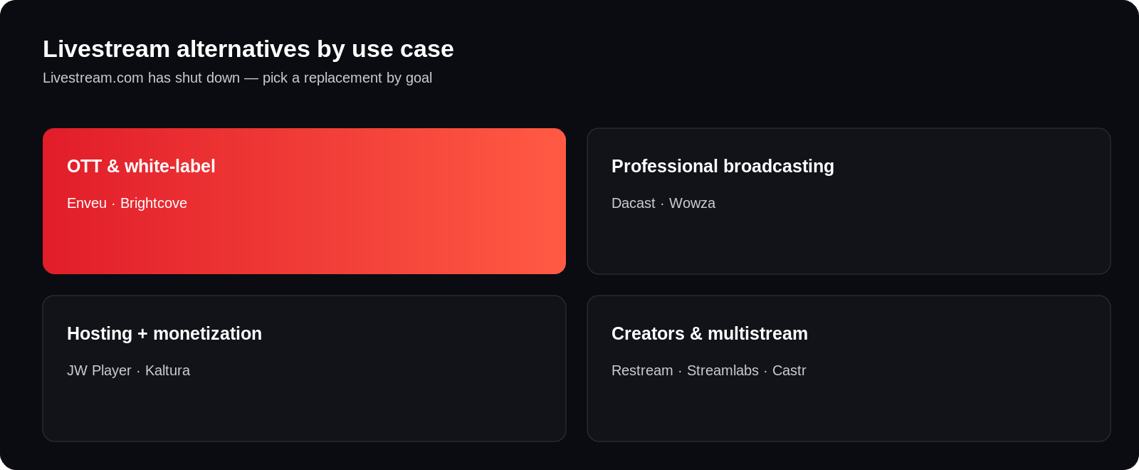
With Vimeo's Livestream.com now discontinued, the best alternatives in 2026 depend on your need: Enveu and Brightcove for full OTT and white-label platforms, Dacast and Wowza for professional broadcasting, JW Player and Kaltura for video hosting with monetization, and Restream or Streamlabs for creators who multistream. Match the platform to your goal, not just its price.
What happened to Livestream (livestream.com)?
Livestream was a well-known live-streaming service acquired by Vimeo in 2017 and marketed as Vimeo Livestream. Over time Vimeo consolidated its products, and it discontinued the Livestream.com platform — users could download their content for a window, after which logins were disabled and videos on livestream.com were removed during 2025. Vimeo continues to offer live streaming within Vimeo, but the standalone Livestream product people knew is gone. That's why so many teams are actively migrating, and why picking the right replacement — not just the closest lookalike — matters.
What to look for in a Livestream alternative
Before comparing names, get clear on what you actually need. Are you broadcasting live events and need multi-source production and low latency? Building a branded OTT service with your own apps and subscriptions? A creator who wants to multistream to YouTube and social? Or hosting on-demand video with monetization? The key criteria are: streaming quality and latency, monetization (subscriptions, ads, pay-per-view), white-label branding and apps, security (DRM, access control), scalability and CDN reach, and ease of use versus depth of control. Different platforms optimise for different points on that spectrum — which is why the "best" alternative is the one that fits your use case.
The best Livestream alternatives in 2026
| Platform | Best for | Key strengths |
|---|---|---|
| Enveu | Branded OTT & white-label streaming | End-to-end platform: live + VOD, your own apps on 15+ platforms, monetization, 0% revenue share |
| Dacast | Professional broadcasting | Live + VOD, DRM-secured delivery, pay-per-view and subscription monetization, white-label |
| Brightcove | Enterprise media & marketing | Global scale, server-side ad insertion, multi-platform delivery to web, mobile and OTT |
| JW Player | Video hosting + advertising | Flexible player, adaptive streaming, strong VAST/VPAID ad and SSAI support |
| Kaltura | Education & large organisations | Open, highly customizable, secure delivery, monetization modules |
| Wowza | Low-latency & custom pipelines | Reliable low-latency streaming, cloud or self-hosted engine, developer control |
| Muvi | No-code all-in-one launch | Launch a live/VOD service without coding, multi-screen apps, built-in billing |
| Restream | Creators & multistreaming | Broadcast to many platforms (YouTube, Facebook, X) at once from the browser |
| Streamlabs | Gamers & live creators | Overlays, widgets and alerts with a friendly interface for social live streams |
| Castr | Simple multistream + restreaming | Easy live restreaming, hosting and scheduling for lean teams |
Which alternative fits your use case?
For a branded OTT service — your own apps, subscriptions and audience relationship — Enveu and Brightcove are built for that end-to-end scope, where the goal is a product, not just a stream. For professional live broadcasting — events, sports, worship — Dacast and Wowza focus on reliable, secure, low-latency delivery with the production controls broadcasters expect. For video hosting with monetization, JW Player and Kaltura pair a capable player with advertising and subscription tooling. For creators who mainly want to go live and reach social audiences, Restream, Streamlabs and Castr make multistreaming simple. And Muvi is the no-code route to launch a service fast. Note that exact pricing shifts often, so confirm current plans directly with each provider — decide on fit first, then compare cost.
Are there free Livestream alternatives?
Some, with limits. Creator-focused tools like Streamlabs and Restream offer free tiers for going live and multistreaming, though extra destinations, storage and watermark removal sit behind paid plans. Professional and OTT platforms — the ones offering monetization, DRM, white-label apps and CDN scale — are paid, because they carry real infrastructure and bandwidth costs. A useful rule: free tiers suit creators broadcasting to social platforms, while businesses building a branded or monetized service will need a paid platform. If budget is the main constraint, start with a creator tool's free tier; if owning your audience and revenue matters, invest in a platform built for it. It also helps to understand the broader IPTV and OTT delivery models before you commit, since they shape what each platform can and can't do.
Best for OTT and white-label: owning your platform
The biggest limitation of most Livestream-style tools is that you're a tenant on someone else's platform — as the Livestream.com shutdown made painfully clear. If live streaming is core to your business, a white-label OTT platform lets you own the whole experience: your brand, your apps across TV, mobile and web, your subscriber data, and your monetization. Enveu is built for exactly this — combining live and on-demand video, subscriptions/ads/pay-per-view via a full monetization stack, DRM security and apps on 15+ platforms, with 0% revenue share. For broadcasters and businesses that want a durable, owned streaming presence rather than a rented one, that ownership is the point.
Best live streaming app for Android
If your question is narrower — the best way to go live from an Android device — the answer depends on audience. Creators streaming to social platforms often use Streamlabs or the native apps of YouTube and their target platforms; teams that want to reach multiple destinations at once use Restream. But if you're delivering live content to your own audience through a branded app, that's an OTT platform decision, not a single-app one — you'd use a platform like Enveu to ship a branded Android (and Android TV) app with live playback built in. Match the tool to whether you're broadcasting to platforms or building one of your own.
Migrating from Livestream: what to do now
If you were a Livestream.com user, the practical steps are straightforward. First, make sure you've recovered any content and source files you still need — the platform's hosted videos were removed after its shutdown window, so locate your originals. Next, pick a replacement by use case using the comparison above, rather than defaulting to the closest lookalike. Then run a short pilot: test a real live stream end to end, checking latency, playback quality on your viewers' actual devices, and that monetization and access controls work as expected. Finally, redirect your audience — update links, embeds and app listings to point at the new platform. Treated as a planned migration rather than a scramble, moving off Livestream is a chance to land on a platform you genuinely own and won't be forced to leave again.
How to choose the right Livestream alternative
Start from your use case, not the feature list. Decide whether you're broadcasting, building a platform, hosting and monetizing, or creating and multistreaming — that single choice narrows the field fast. Then weigh the factors that matter for your case: latency for live events, DRM and access control for premium content, white-label and apps if you're building a brand, and CDN reach if you're global. Finally, confirm current pricing and run a short trial with real content before committing. The Livestream.com shutdown is a useful reminder to choose a platform you can grow with — ideally one where you own your audience and content — so you're never forced into another migration.