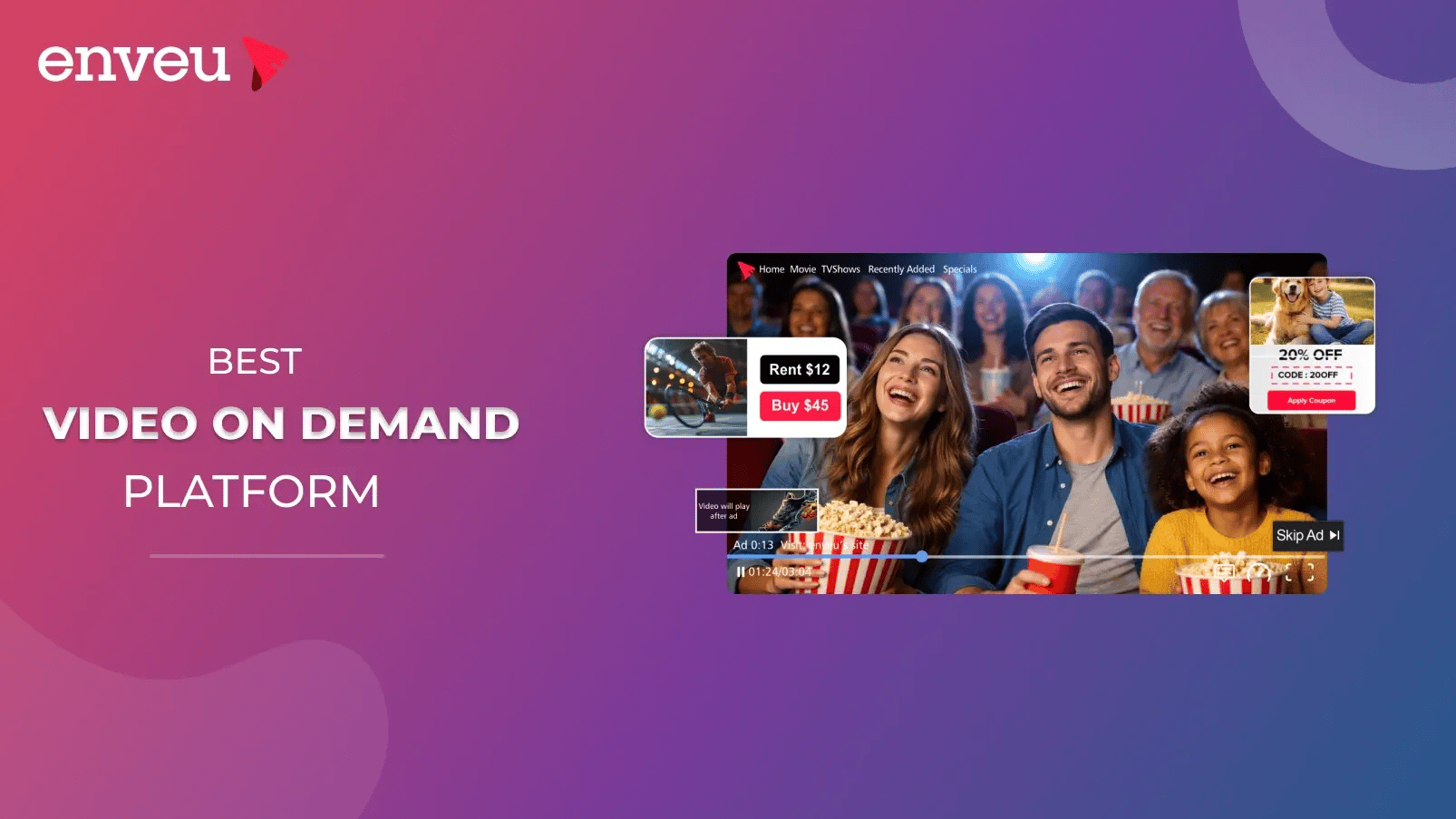
Choosing a video on demand platform is the decision that shapes your entire streaming business — how you host, deliver, brand and monetize your content, and which devices you reach. The market runs from enterprise video suites to turnkey OTT builders to raw streaming infrastructure, and the "best" one depends entirely on what you're trying to launch. This guide compares the leading VOD platforms in 2026 and how to pick the right one. On the operations side, browse media workflow automation use cases that turn live-to-VOD, clipping and subtitling into hands-free pipelines.
What's the best video on demand platform? The best VOD platform delivers adaptive HD streaming, flexible monetization (subscription, ad-supported and pay-per-view), branded apps across mobile and TV, and DRM — from one back end. Enveu, Brightcove, Kaltura, JW Player, Muvi, Wowza, Vimeo OTT and Dacast lead the market; the right pick depends on whether you want a fully-owned white-label service, an enterprise suite, or budget infrastructure.
What is a video on demand platform?
A video on demand (VOD) platform is the software that lets a business host a library of video, deliver it over the internet, and monetize it — so viewers can watch what they want, when they want, on any device. It handles the full stack: content management, transcoding, CDN delivery, user accounts, monetization and analytics. If you want the mechanics of how the streaming itself works, see our guide to how VOD streaming works; this page focuses on choosing the platform to run it on.
Key features to look for in a VOD platform
- Content management — upload, organise and categorise a large library with metadata and access rules.
- Adaptive streaming — multi-bitrate delivery via CDN so playback holds up on any connection.
- Flexible monetization — SVOD, AVOD, TVOD/PPV and hybrid, ideally with no revenue share.
- Branded apps — your own apps on mobile, web and connected TV (Apple TV, Fire TV, Roku).
- Security & DRM — encryption and digital rights management to protect content from piracy.
- Analytics — viewership, retention and revenue data to guide programming and pricing.
Best video on demand platforms in 2026
The leaders split into three camps — fully-owned white-label platforms, enterprise suites, and creator/infrastructure tools. Here's how they compare:
| Platform | Best for | Monetization | Pricing model |
|---|---|---|---|
| Enveu | Brands wanting a fully-owned, white-label VOD/OTT service | SVOD, AVOD, TVOD, PPV, hybrid — 0% revenue share | Tiered, Lite to custom enterprise |
| Brightcove | Enterprises needing scale, security & compliance | Ad + subscription integrations | Custom enterprise quotes |
| Kaltura | Education & enterprise with LMS/video needs | PPV, subscription | Credit / custom packages |
| JW Player | Publishers wanting a strong player + OTT | Ad + subscription (purpose-built) | Custom, usage-based |
| Muvi | All-in-one OTT launch without coding | SVOD, AVOD, PPV, freemium | Monthly tiers |
| Wowza | Developers needing streaming infrastructure | Bring your own (API) | Usage-based |
| Vimeo OTT | Professional creators launching fast | Subscriptions, PPV | Per-subscriber |
| Dacast | Budget-conscious businesses & events | PPV, subscription | Monthly tiers |
Pricing changes often, so treat each as a model and confirm current tiers with the vendor before committing.
A closer look at the top VOD platforms
Enveu is a white-label VOD/OTT platform built for businesses that want to own the whole experience — a branded service with apps on 15+ devices, every monetization model, DRM and live-to-VOD, at 0% revenue share. Brightcove is an enterprise-grade suite favoured by large media and corporate teams for scale, security and compliance. Kaltura pairs video with education and enterprise workflows (LMS integration, open architecture). JW Player combines a best-in-class player with OTT and advertising tools, popular with publishers. Muvi is an all-in-one, no-code way to launch a branded OTT service quickly. Wowza is developer-focused streaming infrastructure for teams that want control over the stack. Vimeo OTT lets professional creators stand up a branded subscription service fast, and Dacast is a budget-friendly pick strong on live events and pay-per-view. Each is capable; the difference is how much you want to own versus configure.
How much does a VOD platform cost?
VOD platform pricing follows a few patterns, and the sticker price rarely tells the whole story. Turnkey and creator platforms typically charge a monthly subscription, sometimes with a revenue share or per-subscriber fee; enterprise suites use custom quotes; and infrastructure tools bill by usage. When comparing, look past the headline number to what's actually included — device apps, DRM, bandwidth, encoding and support are often billed separately and add up fast. A platform that bundles them (and takes no cut of your revenue) can be far cheaper in total than a low monthly fee that nickel-and-dimes every feature. Model your real costs at the scale you expect, not just at launch.
How to choose the right VOD platform
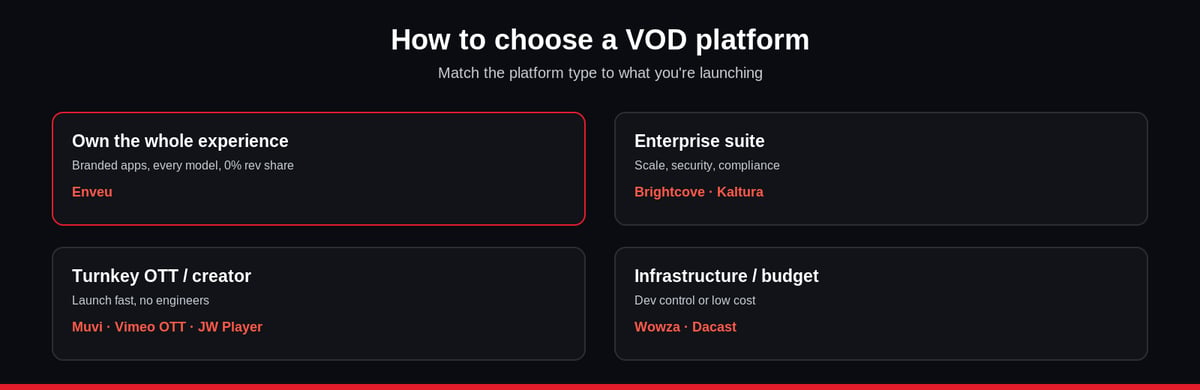
Match the platform to the outcome you want, not the feature list:
- Want to own the whole experience — branded apps on every screen, every monetization model, no revenue share? A white-label platform like Enveu fits.
- Large enterprise with a video team and compliance needs? Brightcove or Kaltura.
- Launching an OTT service fast without engineers? Muvi or Vimeo OTT.
- Developer who wants control of the streaming stack? Wowza.
- Tight budget or live-event focus? Dacast.
Beyond fit, weigh three things buyers often underestimate: total cost (revenue share and per-device app fees add up), device reach (if your audience watches on TV, mobile-and-web-only leaves money on the table), and ownership (building your catalogue inside a marketplace means you don't fully own the customer relationship or data).
VOD platform vs building your own
Some teams weigh buying a VOD platform against building one in-house. Custom development gives total control, but it means engineering a player, transcoding pipeline, CDN integration, billing, DRM and native apps for every device — then maintaining all of it as operating systems and app stores change. That's a large, ongoing cost most media businesses can't justify. A VOD platform collapses that into configuration: the same capabilities, maintained for you, live in weeks instead of quarters. Custom builds only pay off for organisations with highly unusual requirements and the engineering budget to sustain them. For everyone else, choosing the right platform is faster, cheaper and far lower-risk. It's how established subscription services — from Netflix to contract-free players like NOW TV — run, rather than maintaining bespoke stacks.
Common mistakes when choosing a VOD platform
A few avoidable errors cost teams later. Optimising for the lowest monthly price — a cheap tier that charges extra for apps, bandwidth or a revenue share can cost more at scale than an all-inclusive plan. Ignoring device reach — if your audience watches on TV, a platform that only ships mobile and web caps your growth. Overlooking ownership — building your catalogue and audience inside a marketplace means you don't fully own the customer relationship or your data. And underestimating monetization flexibility — your model will evolve, so choose a platform that supports subscriptions, ads and pay-per-view together, not just one. Picking for where you'll be in two years, not just launch week, avoids an expensive migration.
Launch your VOD platform with Enveu
If the goal is a fully-owned video on demand service — your brand, your apps on 15+ platforms, every monetization model, and no revenue share — Enveu's video CMS and multi-platform app suite deliver it from one back end: adaptive-bitrate transcoding up to 4K, integrated CDN, DRM, and SVOD/AVOD/TVOD/PPV/hybrid monetization with live-to-VOD built in. It's the same infrastructure behind 50+ launched OTT platforms. Whichever provider you choose, the principle holds: the best VOD platform is the one that fits your business model and lets you own your audience — not rent it. For teaching specifically, see how to build an educational video subscription platform.
Written by Rishabh Jain, Director of Product Development and co-founder at Enveu.