Online learning has become the default way people upskill — and video is at the heart of it. For educators, coaches, training companies and course creators, that's an opportunity: instead of renting space on someone else's marketplace and handing over a cut, you can run your own educational video subscription platform that hosts your courses, gates them behind subscriptions, and earns recurring revenue on your terms. This guide covers what such a platform is, the features it needs, the monetization models that work for education, and how to actually build one — whether you assemble it yourself or launch on a ready-made platform. The commercial engine behind it is OTT subscription management — plans, trials, billing, taxes and churn control across regions.
An educational video subscription platform lets you host courses and lessons, gate them behind a subscription, and stream securely to any device. To build one you need secure video hosting with DRM, subscription and payment tooling, multi-device apps, interactive learning features (quizzes, live sessions, certificates) and analytics — assembled yourself, or delivered by an OTT platform that provides them out of the box in weeks.
What is an educational video subscription platform?
An educational video subscription platform is a branded video service built specifically for teaching. It combines video-on-demand and live streaming with the tools education needs: structured courses and modules, secure playback that protects your content, subscription billing, progress tracking and interactivity. Unlike posting free videos on a public site you don't control, it lets you own the audience relationship, protect your intellectual property, and earn recurring revenue rather than one-off views. Think of it as combining the streaming experience of Netflix with the learning structure of a course platform — under your own brand.
Why launch an educational video platform now?
The timing is strong. On-demand learning has moved from novelty to expectation — students and professionals want to learn flexibly, anytime, on any device — and the global e-learning market runs into the hundreds of billions of dollars and keeps growing at double-digit rates. Three forces make it a good moment to launch: flexible-learning demand (learners prefer self-paced video), a high-growth market (e-learning adoption keeps rising worldwide), and recurring-revenue potential (subscriptions create steady, predictable income instead of one-time sales). For anyone with teaching expertise, the barrier is no longer whether the market exists — it's choosing how to build.
Must-have features in an educational video platform
| Feature | Why it matters |
|---|---|
| Clean interface & navigation | Simple onboarding, course discovery and a dashboard for progress, bookmarks and upcoming lessons |
| Secure hosting & streaming | DRM, encrypted delivery and a secure CDN to protect paid content from piracy |
| Flexible monetization | SVOD, TVOD, freemium and hybrid so pricing matches how different learners want to pay |
| Interactive learning | Quizzes, assessments, live Q&A, webinars and completion certificates to drive engagement |
| Multi-device access | Web, iOS/Android apps and smart TVs so learners switch screens seamlessly |
| Analytics | Watch time, completion rates, quiz scores and revenue reports to guide what you build next |
Which monetization model is best for education?
Education content suits several models, and the strongest platforms combine them. The table shows the main options.
| Model | How it works | Best for |
|---|---|---|
| SVOD (subscription) | Recurring fee for full library access | Ongoing curricula, membership communities, steady revenue |
| TVOD (transactional) | Pay per course or per lesson | High-value certifications or one-off courses |
| Freemium | Free intro lessons, paid premium content | Reach and acquisition — convert free learners to paid |
| Hybrid | Subscription plus paid add-ons or live cohorts | Most platforms — maximise both reach and revenue |
In practice, a freemium front door feeding a subscription, with the option to sell premium courses individually, covers the widest range of learners. The right platform makes these configurable rather than a rebuild.
How to build an educational video subscription platform (step by step)
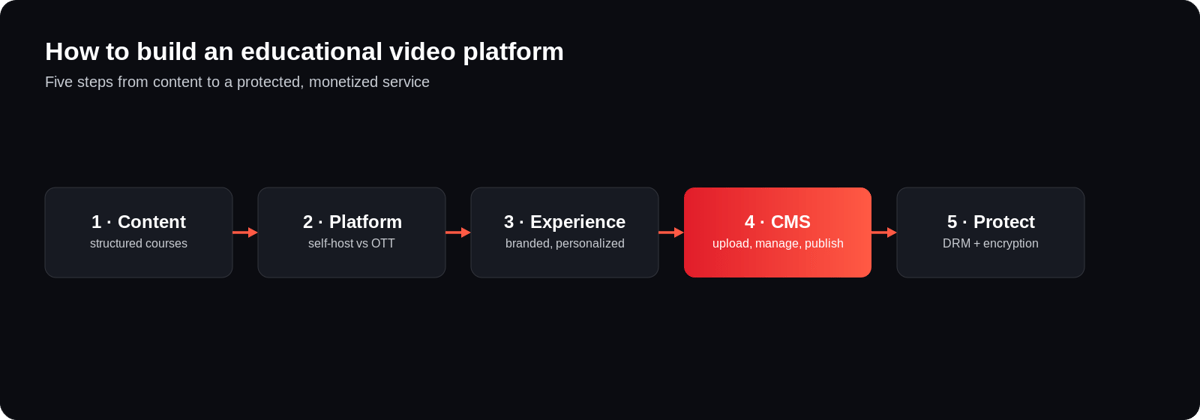
1. Create structured video content. Plan courses as logical modules and lessons with clear learning objectives, add supplemental materials (PDFs, worksheets), and invest in good lighting, clear audio and clean editing. Add subtitles and captions for accessibility.
2. Choose the right platform. Weigh self-hosted (full control, but high complexity, maintenance and upfront cost) against a cloud OTT platform (faster to deploy, scalable, managed). Check for scalability, developer-friendly APIs/SDKs, and a pricing model — monthly fee, per-user, or revenue share — that fits your budget and growth plan.
3. Design a customizable, branded experience. Use your own logo, colours and typography (no third-party branding), add personalized learning paths that recommend courses from a learner's history, and make the journey seamless: easy checkout, onboarding, progress tracking, bookmarks and new-lesson notifications.
4. Set up your content management. A solid video CMS manages your library: drag-and-drop upload for video, PDFs and images; tagging, categorisation and scheduling; role-based user management; multi-platform publishing; and monetization with payment-gateway integration (Stripe, Razorpay, PayPal).
5. Protect your content. Once live, treat your videos like the asset they are — use encryption and DRM to prevent illegal downloads, and watermarking to deter screen recording. This matters most for premium and copyrighted material.
Self-hosted vs an OTT platform: which should you choose?
| Factor | Self-hosted / custom build | OTT platform |
|---|---|---|
| Control | Total control, maximum privacy | High, within a managed system |
| Time to launch | Months of engineering | Weeks — configure, don't build |
| Upfront cost | High; ongoing maintenance | Predictable subscription |
| Scaling & upkeep | Your team owns it all | Maintained for you |
| Best for | Unusual requirements + engineering budget | Most educators and training businesses |
Educational streaming beyond on-demand
Education isn't only pre-recorded. Many platforms blend live and on-demand: live cohort classes, webinars and Q&A sessions alongside a library of recorded courses, with the live sessions auto-recorded into VOD afterwards. This live-plus-on-demand mix is one of the strongest engagement drivers — it adds the accountability of a scheduled class to the flexibility of self-paced video. It's also part of the broader shift toward OTT in education, where learning content is delivered over the internet to any device the way streaming services deliver entertainment. A capable platform supports both modes from the same back end, so you don't stitch together separate live and VOD tools.
What to look for in a video platform for education
If you're comparing "best video platforms for education," judge them against what teaching actually requires — not just video hosting. The essentials: secure, DRM-protected playback so paid courses can't be ripped; flexible subscription and payment tooling (SVOD, per-course, freemium) with real gateway integration; both live and on-demand from one system; apps across web, mobile and TV; learning-friendly features like progress tracking, quizzes and certificates; and analytics that show completion, not just views. Equally important is the commercial model — check whether the provider takes a revenue share on your subscriptions, since that quietly erodes margin as you grow. The best fit is the platform that covers this whole list under your own brand, so learners experience your product rather than a third party's.
Launching your platform with Enveu
Building all of this yourself — secure hosting, DRM, subscriptions, apps, live and VOD, analytics — is a large undertaking. Enveu's education platform provides it as one system: Content Manager handles uploads, live and on-demand, and multi-platform publishing; monetization spans SVOD, TVOD, freemium and hybrid via a full monetization stack with payment-gateway integration; DRM and encryption protect your courses; and branded apps ship to web, mobile and TV — with 0% revenue share. You focus on great teaching and a strong learner experience; the streaming, security and billing infrastructure is done. For educators and training businesses that want to launch fast and own their audience, that's the difference between a multi-month build and a service that's live in weeks.