Streaming didn't stay in entertainment. Schools, universities, coaching institutes and upskilling brands now deliver courses the same way Netflix delivers shows — over the internet, on any device, live or on demand. This is OTT in education: what it means, how it works, the benefits, the ways it makes money, and where it's headed. To reach multilingual audiences, Enveu Flow can automate subtitle and metadata translation across every title.
OTT stands for "over-the-top," and OTT in education means delivering learning content — live classes, recorded lectures, courses and interactive sessions — over the internet directly to learners' devices, bypassing traditional classrooms and cable. Students access it on phones, tablets, laptops and TVs, usually via a subscription or per-course fee. It makes learning flexible, on-demand, scalable and measurable.
What does OTT mean? (full form)
The full form of OTT is "over-the-top." It describes any video or audio delivered over the top of the open internet, instead of through cable, satellite or a fixed broadcast network. Netflix, YouTube and Disney+ are OTT; so is any branded learning app that streams lessons to students. For the wider definition, see what OTT means in broadcasting. Applied to learning, "OTT" simply means the internet-delivered model has come to education.
What is OTT in education?
OTT in education is the delivery of educational content — live or on-demand — through an internet streaming platform, so learners anywhere can watch on the device of their choice. Instead of a fixed timetable and a physical room, an educational OTT platform gives students a library of lectures, live sessions, quizzes and doubt-clearing videos they can access on their own schedule. It's a win-win: learners get flexibility and choice, and educators or edtech businesses get a scalable, global, directly-monetizable channel for their content.
How does educational OTT work?
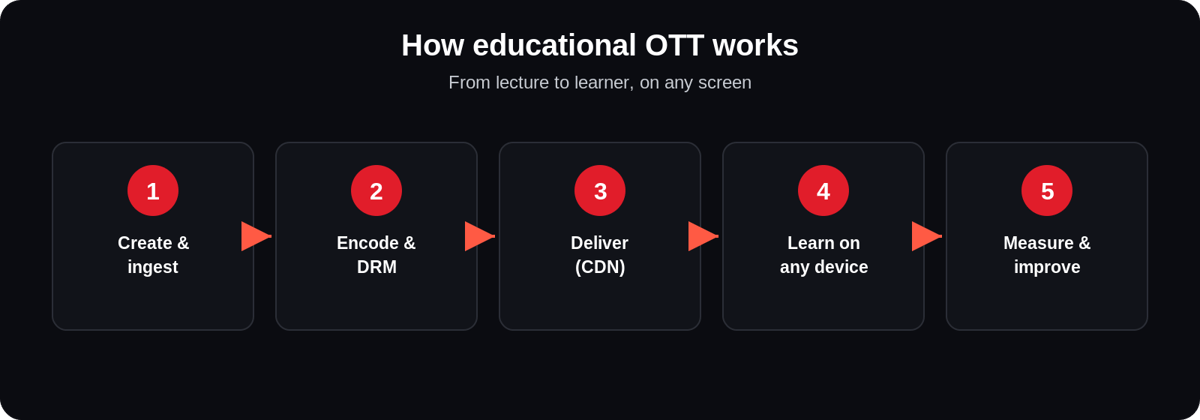
- Create & ingest — educators upload live sessions, recorded lectures, quizzes and materials into a content library (CMS).
- Encode & protect — video is transcoded to adaptive quality and secured with DRM so paid courses can't be pirated.
- Deliver — a CDN streams content buffer-free to learners across regions and devices.
- Learn & interact — students watch on-demand or join live, take quizzes and polls, and revisit recordings anytime.
- Measure — the platform tracks watch time, completion and engagement, so educators see what's working and improve it.
Benefits of OTT in education
| Benefit | Why it matters |
|---|---|
| Flexibility | Learn anytime, from anywhere, on any device — ideal for working professionals and remote learners |
| No location barrier | A student in a remote town gets the same class as one in a city — no travel, no relocation |
| Self-paced learning | Rewatch recorded lectures as often as needed; learn at the pace each student needs |
| Scalability | One educator can reach thousands of students at once, unconstrained by classroom size |
| Personalization | Recommendations, tailored paths and interactive elements keep learners engaged |
| Analytics | Per-student performance data shows where learners struggle, so teaching can adapt |
OTT for schools, higher education and beyond
The model fits many corners of learning. Schools (K-12) use it for recorded lessons, revision and parent-visible progress. Higher education streams lectures, seminars and hybrid degree content to on- and off-campus students. Coaching and test-prep institutes run live classes plus an on-demand library for exam preparation. Corporate learning and upskilling platforms deliver training, certifications and compliance courses to employees worldwide. And independent educators and creators launch their own branded course apps to teach a niche and earn directly — increasingly common as the tools become affordable off the shelf.
How do educational OTT platforms make money?
| Model | How it works |
|---|---|
| Subscription (SVOD) | A recurring fee unlocks the full course library — the most common model |
| Pay-per-course / per-session | Learners buy a specific course, module or live session (transactional) |
| Freemium | Some lessons free to attract users, with premium content behind a paywall |
| Ad-supported (AVOD) | Free access funded by advertising — widens reach, lowers the barrier to entry |
Most successful platforms blend these — a free tier for reach, subscriptions for steady revenue, and one-off course sales on top. See the full picture in our video monetization guide.
Challenges of OTT in education
It isn't friction-free. Engagement is harder at a distance, so interactivity — live Q&A, quizzes, gamification — matters more than in a classroom. Content security is critical, since paid courses are easy to copy without DRM. Reliable delivery across weak connections needs adaptive streaming so video doesn't buffer. And the technology itself — a video CMS, apps for every device, payments and analytics — is a real build. The platforms that win pick tooling that solves these out of the box rather than assembling it piece by piece. There's also a discovery challenge: a growing library only helps if learners can find the right lesson quickly, so good search, categorisation and recommendations matter as much as the content itself. Solve engagement, security, delivery and discovery together, and an educational OTT service becomes something students genuinely prefer to a classroom for many kinds of learning.
What content works on educational OTT
Almost any teaching that benefits from video fits the model. Recorded lectures and courses form the on-demand backbone learners revisit at their own pace. Live classes and webinars add real-time teaching, Q&A and a sense of a cohort. Exam and test prep — a library of concept videos plus timed practice — is a natural, high-demand category, especially in markets with competitive entrance exams. Skill and professional courses (coding, design, business, certifications) suit working learners who study around a job. Tutorials and micro-lessons — short, single-topic videos — drive high completion and easy discovery. And doubt-clearing and mentorship sessions, live or recorded, add the human support that keeps learners engaged. A strong platform mixes on-demand depth with live touchpoints, so students get both flexibility and connection.
OTT in education vs a traditional LMS
People often confuse an educational OTT platform with a learning management system (LMS), but they solve different problems. An LMS (Moodle, Canvas and the like) is built around courses, assignments, grading and administration — the structure of a program. An OTT platform is built around video: high-quality live and on-demand streaming, adaptive delivery, a Netflix-style discovery experience, DRM and flexible monetization. The best modern learning products use both — an OTT layer for the viewing experience and video monetization, and an LMS-style layer for coursework and certification. If your value is primarily in video teaching — lectures, live classes, a streamable library people pay to watch — the OTT model is what makes it fast, scalable and directly monetizable, often on a subscription (SVOD) basis.
The future of OTT in education
Educational streaming is still accelerating, shaped by a few clear trends. Mobile-first learning keeps growing as smartphones become the primary screen, especially in emerging markets. Micro-learning — short, focused video lessons — suits on-the-go study and lifts completion rates. AI is adding personalized paths, auto-generated subtitles and translations to reach global learners, and smarter recommendations. And interactivity — live Q&A, quizzes, gamified progress — is closing the engagement gap with the physical classroom. The through-line: education is becoming a streaming experience, and the institutions and creators who own a branded platform (rather than renting space on someone else's) capture the audience, the data and the revenue.
Launch your educational OTT platform with Enveu
Building a learning platform means more than uploading videos: you need a content library, adaptive delivery, live and on-demand playback, DRM, subscriptions or per-course payments, apps on mobile, web and TV, and learner analytics. On Enveu's education streaming solution you can launch a branded platform in weeks — live classes and lecture replays, an on-demand library, quizzes and interactivity, DRM-secured content, and SVOD/AVOD/transactional monetization with 0% revenue share — across web, mobile and connected TV. It's part of Experience Cloud, so one back end powers your whole learning service. To go further, see how to build an educational video subscription platform.