When you stream premium video, one question comes up fast: how do you stop someone from simply grabbing the video files off the network and redistributing them? HLSe is one of the most common answers. It takes the widely used HLS streaming protocol and encrypts the video, so that even if someone intercepts the stream, they get scrambled data they can't play. It's the practical middle ground between shipping content in the clear and standing up a full DRM system — and it's why "HLSe" shows up behind so much protected streaming. Here's exactly what it is, how it works, and where its limits are.
HLSe stands for HTTP Live Streaming with Encryption — the HLS protocol with its video segments encrypted using AES (usually AES-128). The player can only decrypt and play the stream after fetching a key from a separate, authenticated key server, so intercepted segments are useless without it. It's a lightweight way to protect streaming content, short of a full DRM system.
What is HLSe?
HLSe is HTTP Live Streaming with Encryption — standard HLS with an encryption layer applied to the media. In plain terms, the video is chopped into short segments (as HLS always does), and each segment is scrambled with an AES encryption key before it's delivered. The player downloads the segments as usual, but it can't play them until it retrieves the matching decryption key from a key server — and it only gets that key if the viewer is authenticated. So the content travels encrypted across the network and sits encrypted on the CDN, and only an authorised player can turn it back into watchable video. HLSe keeps all of HLS's strengths — adaptive quality, broad device support, HTTP delivery — and adds confidentiality on top.
What does HLS stand for, and how does HLSe extend it?
HLS stands for HTTP Live Streaming, Apple's adaptive-bitrate streaming protocol and the most widely supported way to deliver video over the internet. It works by encoding video into multiple quality renditions, splitting each into short segments, and listing them in a text .m3u8 playlist the player reads to fetch segments and switch quality as bandwidth changes. Plain HLS, though, delivers those segments unprotected — anyone who can reach the URLs can download the video. HLSe closes that gap: it's the same HLS, with the segments encrypted and a key-exchange step added. The "e" is simply encryption. Everything that makes HLS the default — CDN-friendly HTTP delivery, playback on phones, TVs and browsers, adaptive quality — still applies; HLSe just makes the payload unreadable without a key.
How does HLSe work?
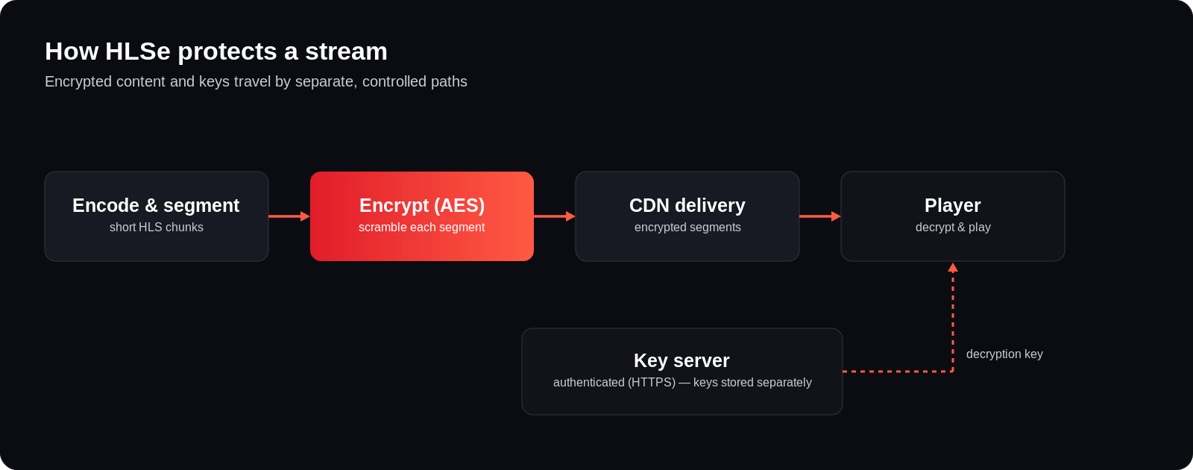
HLSe follows the normal HLS pipeline with two extra steps — encryption and key management. First, the video is encoded and segmented into short chunks (typically 2–10 seconds). Before delivery, each segment is encrypted with an AES key. The playlist manifest is written so it references not just the segment URLs but also the encryption method and the URI where the key lives (via the #EXT-X-KEY tag). Crucially, the keys are stored separately from the video — on a dedicated key server, not the CDN — and are handed out only after the viewer's device is authenticated, usually over HTTPS with a token. On the client side, the player reads the manifest, downloads the encrypted segments, requests the key, and — if authorised — decrypts and plays in real time. Because content and keys travel by separate, controlled paths, an attacker who scrapes the segments off the CDN still can't watch them.
AES-128 vs SAMPLE-AES: the two HLS encryption methods
HLS defines two AES-based encryption modes, and it's worth knowing which is which.
| AES-128 | SAMPLE-AES | |
|---|---|---|
| What it encrypts | The entire media segment, byte for byte | Only the audio/video samples inside the segment, leaving container structure readable |
| Manifest tag | #EXT-X-KEY:METHOD=AES-128 | #EXT-X-KEY:METHOD=SAMPLE-AES |
| Typical use | General HLSe content protection | Required for Apple FairPlay DRM; enables per-sample protection |
| Key length | 128-bit (AES also supports 256-bit) | 128-bit |
When people say "HLSe", they usually mean AES-128 encrypted HLS — full-segment encryption with keys served from an authenticated endpoint. SAMPLE-AES is the mode that underpins FairPlay, bridging simple encryption and full DRM.
HLSe vs DRM: what's the difference?
This is the single most important thing to understand — HLSe is not the same as DRM, and treating them as equivalent leads to security surprises. HLSe encrypts content and controls who gets the key. DRM (Widevine, PlayReady, FairPlay) does that and adds a hardened licence exchange, device-level trust, and output protections like blocking screen capture or forcing HDCP. HLSe is lighter and simpler; DRM is stronger but heavier.
| Factor | HLSe (AES encryption) | DRM (Widevine/PlayReady/FairPlay) |
|---|---|---|
| Protects against | Casual interception, direct URL grabbing, CDN scraping | The above, plus copying, screen capture and device-level attacks |
| Key/licence handling | AES key from an authenticated server | Licence from a DRM system, tied to a secure device component |
| Output protection | None | HDCP, capture blocking, watermarking support |
| Complexity & cost | Lower — easy to add to HLS | Higher — licence servers, multi-DRM, per-platform work |
| Best for | Moderately sensitive content, corporate/e-learning, deterring casual piracy | Premium studio content, live sports, anything with strict licensing |
Is HLSe secure?
HLSe meaningfully raises the bar: content is unreadable in transit and at rest on the CDN, and access depends on authenticated key delivery, so it defeats casual interception and direct link-sharing. But it isn't bulletproof. Its weak point is key delivery — if the key endpoint isn't properly authenticated and served over HTTPS, an attacker who obtains the key can decrypt the content. And once a legitimate device has decrypted the stream, HLSe does nothing to stop screen recording or re-capture, because it has no output protection. So HLSe is a strong, sensible choice for content that needs protecting from opportunistic piracy — corporate video, e-learning, gated events — but for high-value premium content under strict licensing, you'll want full DRM. The two aren't mutually exclusive: many platforms use AES/HLSe as a baseline and layer DRM on top for premium tiers.
When should you use HLSe?
HLSe is the right tool when you need real protection without the overhead of a full multi-DRM setup. It suits corporate and internal video (town halls, training) where you mainly need to stop unauthorised access; e-learning and course platforms protecting paid lessons; gated live events and webinars; and OTT services that want a security baseline across every device, often alongside DRM for premium content. Because it's built on standard HLS, it works across the same broad device range — iOS, Android, web, smart TVs — and slots into existing CDN delivery without special infrastructure. If your content is highly valuable or contractually requires DRM, use DRM; for everything in between, HLSe is an efficient, widely compatible way to keep your streams protected.
Delivering encrypted HLS with Enveu
Setting up HLSe correctly — encrypting segments, running an authenticated key server, writing the right manifest tags, and delivering globally over a CDN — is exactly the kind of plumbing a streaming platform should handle for you. Enveu's platform delivers adaptive-bitrate HLS with encryption and secure key exchange built in, and for premium content its DRM & security layer adds multi-DRM (Widevine, PlayReady, FairPlay), encryption and watermarking — so you can apply the right level of protection per content tier without building key servers and DRM integrations yourself. Whether you're securing corporate video, e-learning or a full OTT service, you get standards-compliant, protected HLS delivery across every device from one platform. Pair it with the right ingest and delivery setup and your content stays protected end to end. The encryption method itself is declared in the stream's manifest file.