Video on Demand streaming is how most of the world now watches — on its own schedule, on any screen, with no broadcast clock to obey. But behind that simple experience sits a real pipeline: files are ingested, transcoded, cached on a global network and delivered adaptively to each viewer. This guide explains what VOD streaming is, how it actually works, how it differs from live, how live streams become on-demand, and how it makes money.
What is VOD streaming? VOD (Video on Demand) streaming is the delivery of pre-recorded video over the internet so viewers can watch whenever they choose, on any device. When a viewer hits play, the video is streamed from the nearest server on a content delivery network (CDN) at a quality matched to their connection — no fixed schedule, full control to pause, rewind and resume.
What is VOD streaming?
VOD streaming delivers video content over the internet on demand — the viewer, not a broadcaster, decides what to watch and when. Unlike traditional TV with its fixed schedule, a VOD service hosts a library that plays on smartphones, tablets, computers and smart TVs at the tap of a button. It covers everything from movies and series to courses, corporate training and creator content. The defining trait is convenience: content is always available, and viewers can pause, rewind and pick up where they left off.
How does VOD streaming work?
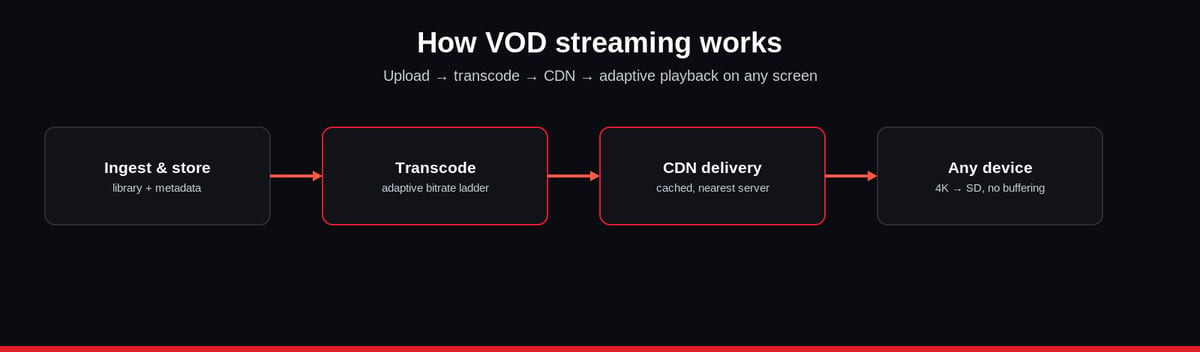
Getting a video from your library onto a viewer's screen involves four stages:
- Ingest & store. Source files are uploaded to the platform and organised into a catalogue with metadata, thumbnails and access rules.
- Transcode. Each file is encoded into multiple resolutions and bitrates (an adaptive bitrate ladder), so it can play smoothly on any connection.
- Distribute via CDN. The renditions are cached across a content delivery network. When a viewer requests a video, the CDN serves it from the nearest server, minimising buffering and latency.
- Adaptive playback. The player continuously picks the best rendition the viewer's bandwidth can sustain, stepping quality up or down in real time so playback never stalls.
That CDN-plus-adaptive-bitrate combination is what lets a single title serve one viewer in 4K on fibre and another in SD on mobile data, at the same time, without either buffering.
VOD vs live streaming: what's the difference?
Both deliver video over the internet, but they behave very differently:
| Factor | VOD streaming | Live streaming |
|---|---|---|
| Content | Pre-recorded, ready in a library | Broadcast in real time |
| Timing | Watch anytime, on demand | Only during the broadcast |
| Viewer control | Pause, rewind, fast-forward | Controlled by the broadcaster |
| Latency | Not time-critical | Low latency is essential |
| Best for | Catalogues, courses, series | Events, sports, sales, IRL |
Live-to-VOD: turning live streams into on-demand
The two aren't mutually exclusive — the strongest services do both, and connect them. Live-to-VOD (sometimes searched as "broadcast VOD" or "VOD to live") is the workflow of automatically recording a live stream and publishing it to your on-demand library the moment it ends. A live match, webinar or class is broadcast once, then instantly becomes a replay anyone can watch later. This matters because live creates urgency and audience, while VOD captures the long-tail value — every live event keeps earning as on-demand content instead of disappearing when the stream stops. A good platform handles this automatically: it ingests the live feed (via RTMP or SRT — see RTMP vs HLS), records it, transcodes it, and adds it to the catalogue with no manual re-upload.
VOD monetization models
VOD only becomes a business when it earns. Four models dominate, and most successful services combine them:
| Model | How it works | Example |
|---|---|---|
| SVOD | Recurring subscription for unlimited library access | Netflix, Disney+ |
| AVOD | Free to viewers, funded by ads | YouTube |
| TVOD | One-time rent or buy per title (pay-per-view) | Amazon, Google Play |
| PVOD | Premium price for early/exclusive releases | New-release rentals |
SVOD builds predictable recurring revenue; AVOD maximises reach; TVOD/PVOD monetise high-value one-off content. A flexible monetization platform lets you run several at once — subscriptions for regulars, PPV for premieres, ads on a free tier.
What devices can play VOD streaming?
One of VOD's biggest advantages is reach: the same catalogue plays across nearly every screen. Viewers watch on smartphones and tablets (iOS and Android apps), web browsers on laptops and desktops, smart TVs, and dedicated connected-TV apps on Apple TV, Fire TV, Roku and Android TV. A well-built VOD service ships the same login, library and playback experience to all of them from one back end, so a viewer can start a title on their phone and finish it on the living-room TV. "Internet VOD" simply refers to this — video-on-demand delivered over the open internet rather than a cable set-top box.
Common VOD streaming challenges (and how platforms solve them)
Running a VOD service at scale raises a few recurring problems, each with an established fix. Buffering and quality on varied connections is solved by adaptive-bitrate transcoding plus a CDN, which together match quality to bandwidth and serve from the nearest edge. Piracy and unauthorised sharing are addressed with DRM, encryption and token-based access control. Scale — sudden spikes when a popular title drops — is handled by cloud infrastructure and multi-CDN delivery. And content discovery, the challenge of surfacing the right title from a large library, is tackled with search, categorisation and AI-driven recommendations. Choosing a platform that solves all four out of the box is what separates a reliable service from a fragile one.
Benefits of VOD streaming
For viewers, VOD means convenience, choice, cross-device access and personalised recommendations. For the business, it means a scalable, ownable revenue channel: a library that earns around the clock, reaches a global audience from one catalogue, and generates the watch-time and retention data you need to program smarter. Unlike a broadcast slot that airs once, a VOD title keeps working — which is why VOD is the backbone of modern streaming economics.
Is VOD the same as OTT streaming?
The terms overlap but aren't identical. OTT (over-the-top) describes how content is delivered — over the open internet, bypassing traditional cable or satellite. VOD describes what is delivered — pre-recorded, on-demand content. So VOD is one type of content that OTT services deliver, alongside live channels and FAST (free ad-supported streaming TV). Netflix is an OTT service that is primarily VOD; a live sports OTT app is OTT but not VOD. In practice, most modern OTT platforms offer both a VOD library and live channels, which is exactly why the live-to-VOD workflow matters — it lets one platform serve both from a single catalogue and back end.
Launch your own VOD streaming service
Turning this into a live product means a platform that handles the whole pipeline — ingest, transcoding, CDN delivery, DRM, apps and monetization — without you assembling it piece by piece. Enveu's video CMS and streaming platform manage your library, run adaptive-bitrate transcoding up to 4K, deliver via integrated CDN, and support SVOD, AVOD, TVOD, PPV and hybrid models with live-to-VOD built in, across 15+ device platforms from one back end. If you're at the stage of choosing a provider, see our comparison of the best video on demand platforms to weigh the options. The takeaway: VOD streaming is no longer just how people watch — it's how a modern media business scales.
Written by Rishabh Jain, Director of Product Development and co-founder at Enveu.