For decades, running a TV channel meant racks of hardware — encoders, playout servers, storage — sitting in a broadcast facility, expensive to buy and slow to change. Cloud TV flips that model. Instead of owning the equipment, broadcasters and operators run the whole chain as software in the cloud and stream to any screen. It's the shift that lets a new channel or streaming service launch in weeks instead of years, and it's why "cloud TV" has become one of the most searched terms in the media-technology space. Here's what it actually means, how it works, and how it differs from OTT. Running a channel at scale increasingly means OTT workflow automation — automating live-to-VOD, metadata and packaging rather than doing them manually.
Cloud TV is a model for delivering television — live channels, video on demand and DVR — from cloud infrastructure instead of on-premise broadcast hardware. Operators run playout, encoding, storage and the viewer interface as cloud services, then stream to phones, smart TVs, set-top boxes and the web — cutting upfront cost and letting them scale channels, content and features on demand.
What is cloud TV?
Cloud TV (sometimes written "cloud television" or "cloud-based TV") is the delivery of a full TV experience from cloud infrastructure rather than dedicated broadcast hardware. In a traditional setup, a broadcaster owns and operates the encoders, playout automation, storage and middleware needed to run channels. With cloud TV, those same functions run as managed software services hosted in data centres, and the content is streamed to viewers over the internet. For the viewer, it feels like normal TV — live channels, on-demand libraries, the ability to pause and rewind — accessible from any internet-connected device through a personal account. For the operator, it removes the capital cost and rigidity of hardware: you spin up channels, add features and scale capacity on demand, paying for what you use. In short, cloud TV means the TV platform lives in the cloud, not in a rack.
How does cloud TV work?
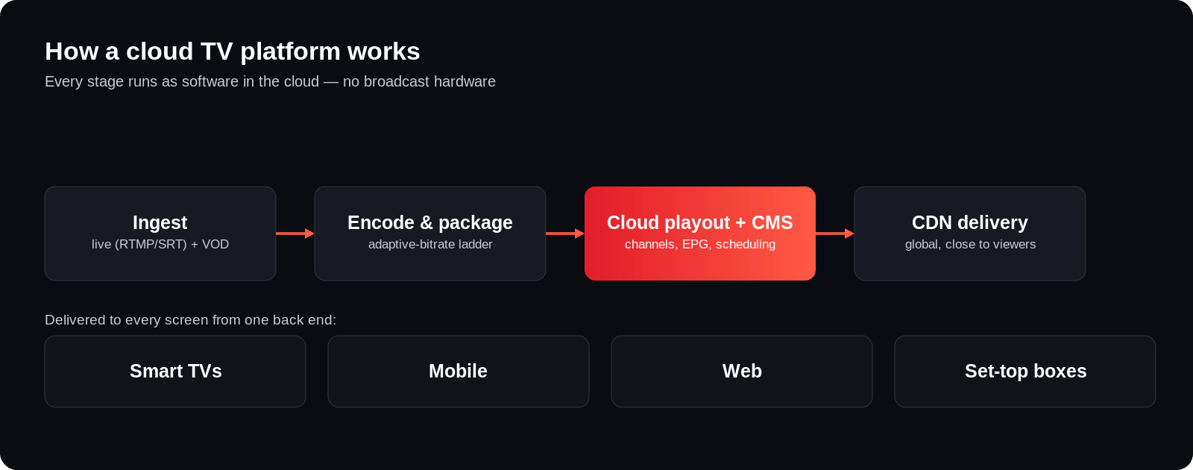
A cloud TV platform runs the same pipeline a broadcast facility does, only virtualised. Content and live signals are ingested into the cloud (a live feed via RTMP or SRT, or VOD files uploaded to a content management system). They're encoded and packaged into an adaptive-bitrate ladder — multiple qualities so playback adjusts to each viewer's connection. Cloud playout assembles live channels, schedules and ad breaks, driven by an electronic programming guide. A CDN distributes the streams globally, close to viewers, and apps on every device — smart TVs, mobile, web, set-top boxes — play them back through a unified user account. Because every stage is software, an operator can add a channel, change a schedule or roll out a feature without touching physical equipment. That's the core of how cloud TV works, and why it's so much faster to operate than legacy broadcast.
Cloud TV vs OTT TV: what's the difference?
This is the question most people arrive with, and the short answer is that they describe different things: cloud TV is about where the platform runs (in the cloud); OTT is about how content reaches the viewer (over the internet, "over the top" of traditional cable/satellite). They overlap heavily — most OTT services run on cloud infrastructure, and most cloud TV platforms deliver over the top — but they aren't synonyms. The table breaks it down.
| Cloud TV | OTT TV | |
|---|---|---|
| What it describes | Where the TV platform runs — playout, encoding, storage and UI delivered as cloud services | How content is delivered — streamed over the internet, bypassing cable/satellite |
| Primary focus | The operator's back-end infrastructure and operations | The viewer's access model and experience |
| Key traits | On-demand scalability, pay-per-use, cloud playout, no on-prem hardware | App-based, personalised profiles, multi-device, subscription/ad monetization |
| Examples | Cloud playout and channel-origination platforms powering operators and broadcasters | VOD and streaming services like Netflix, Disney+, Prime Video |
| Relationship | Complementary — a modern OTT service is typically built on cloud TV infrastructure | |
Cloud TV vs traditional broadcast TV
| Factor | Traditional broadcast | Cloud TV |
|---|---|---|
| Upfront cost | High — buy and house encoders, playout, storage | Low — pay-as-you-go cloud services |
| Time to launch a channel | Months, tied to hardware procurement | Days to weeks, software-configured |
| Scaling | Buy more hardware for peaks | Elastic — scale up for a big event, down after |
| Reach | Fixed footprint (cable/satellite region) | Any internet-connected device, worldwide |
| Updates | Slow release cycles | Continuous — ship features without a hardware refresh |
Key capabilities of a cloud-based TV platform for operators
If you're an operator or broadcaster evaluating cloud TV, these are the capabilities that matter. A serious platform should provide: live and VOD ingestion (RTMP/SRT for live, bulk upload and APIs for VOD); cloud transcoding into an adaptive-bitrate ladder up to 4K; cloud playout and channel origination with scheduling, graphics and ad markers; an EPG for live channels and linear/FAST channel support; a CMS to manage metadata, catalogues and rights; multi-DRM and geo-blocking to protect and license content; monetization across subscription, ad-supported and transactional models; apps for every screen from one back end; and analytics on viewership and quality of experience. The goal is a single platform that replaces a room full of specialised systems — and lets a small team run what used to require a broadcast operations centre.
The cloud TV market
Cloud TV is a fast-growing category, though exact figures vary by how analysts define it. Estimates commonly place the cloud TV market in the low single-digit billions of dollars in 2025 — for example, one widely cited analysis pegs it around USD 3.2 billion in 2025, growing at roughly 18–19% a year to about USD 7.5 billion by 2030 — with other firms projecting double-digit CAGRs on similar horizons. Whatever the precise number, the direction is clear: broadcasters and telecoms are migrating off on-premise hardware to cut cost and move faster, and new streaming services are being built cloud-first by default. Growth is strongest where internet penetration is rising and where operators want to launch IP-delivered TV without the capital burden of traditional infrastructure.
Benefits of cloud TV for broadcasters and operators
The advantages line up directly against the pain points of legacy broadcast. Lower upfront investment, because you rent infrastructure instead of buying it. Scalability and elasticity — handle a major live event, then scale back down, without idle hardware. Faster innovation, since features ship as software updates rather than waiting for the next hardware cycle. Streamlined operations, with fewer systems to maintain and a smaller technical team. Global reach, delivering to any device anywhere via CDN. And data-driven programming, because a cloud platform captures detailed viewership analytics you can act on. Together these turn TV from a capital-heavy, slow-moving operation into an agile, software-defined business — which is exactly why the migration to cloud is accelerating.
How to choose a cloud TV provider
Choosing a cloud TV platform comes down to a few questions. Does it cover your full pipeline — ingest, transcoding, playout, CMS, apps and monetization — or will you have to stitch several vendors together? Can it deliver reliably to a global audience at the scale and quality you need? Does it support the monetization models you plan to run, and does it take a cut of your revenue? And how quickly can you launch and iterate? Enveu's platform is built for exactly this: Content Manager handles EPG ingestion, cloud playout and adaptive-bitrate transcoding up to 4K, ingests RTMP/SRT and delivers via integrated CDN; a full video CMS manages live and VOD at scale; monetization spans SVOD, AVOD, TVOD and hybrid with 0% revenue share; and branded apps ship to 15+ platforms — TV, mobile and web — from one back end. It's a cloud TV stack designed to launch a service in weeks and run it lean, whether you're a broadcaster going direct-to-consumer or an operator originating channels for a global audience.