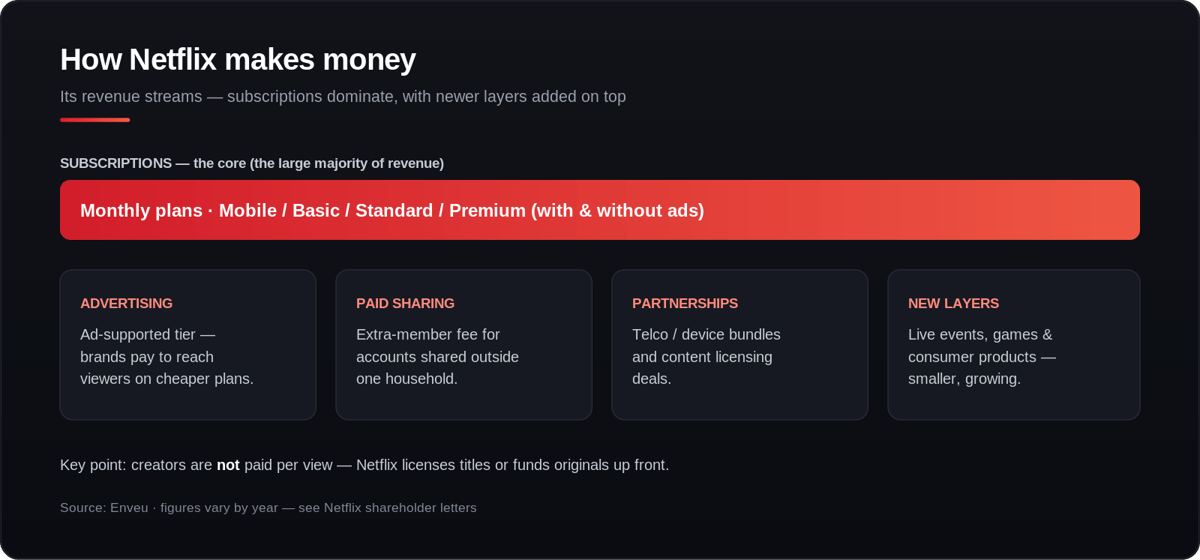
Netflix makes money mainly from paid subscriptions — monthly plans across mobile, basic, standard and premium tiers, in both ad-free and cheaper ad-supported versions. On top of that core, it now earns from advertising (its ad tier), paid sharing (an extra-member fee), and partnerships and licensing — with smaller, growing lines from live events, games and consumer products. Subscriptions still drive the large majority of revenue.
Netflix's revenue streams at a glance
| Revenue stream | How it works | Scale |
|---|---|---|
| Subscriptions | Recurring monthly fees across tiers (ad-free and ad-supported) | Core — the large majority |
| Advertising | Brands pay to reach viewers on the ad-supported plan | Growing |
| Paid sharing | Extra-member fee for accounts used outside one household | Meaningful add-on |
| Partnerships & licensing | Telco/device bundles; licensing some titles to others | Supplementary |
| New layers | Live events, games and consumer products | Small, emerging |
Subscriptions: Netflix's core revenue
Netflix is a subscription-first business: the recurring fee from paid memberships is where the large majority of its money comes from. Plans are tiered so different viewers self-select — from a low-cost mobile/basic tier up to a premium 4K, multi-screen plan — and each tier now comes in an ad-free version and a cheaper ad-supported version.
- Mobile / Basic — lowest cost, limited resolution and simultaneous screens.
- Standard — Full HD, more screens; available with or without ads.
- Premium — 4K/HDR, most simultaneous screens and downloads.
Exact prices vary by country and change over time — check Netflix's site for your region. Pricing is set against local competition and Netflix's own content costs.
How do movies and shows make money on Netflix?
This is where most explanations get it wrong. Netflix does not pay creators per view — it is not YouTube. There is no "per 1,000 views" or "per 1 million views" payout. Instead, Netflix pays for content in one of two ways:
- Licensing — it pays a rights holder a fee to stream a title for a period.
- Originals — it funds a production up front (often a cost-plus deal), and owns or controls the result.
So a film or series doesn't "earn" money for its makers based on Netflix view counts; the makers are paid through the licensing or production deal, and Netflix recoups that cost through subscriptions and ads. View data mainly informs what Netflix commissions next.
How Netflix makes money beyond subscriptions
- Advertising: the ad-supported tier lets brands buy reach against Netflix's audience — a second revenue line layered on the subscription base.
- Paid sharing: households can add an "extra member" for a fee instead of sharing a password for free — converting informal sharing into revenue.
- Partnerships & bundles: telcos and device makers bundle Netflix into their packages, widening distribution.
- New layers: live events (e.g. sports and specials), mobile games, and consumer products/experiences add smaller, growing income and keep engagement high.
Netflix's scale
Netflix operates in 190+ countries with hundreds of millions of paid memberships — the largest of any subscription streaming service. Subscriptions remain the dominant revenue source, with advertising and paid sharing adding newer growth. Netflix publishes the specifics in its quarterly shareholder letters — see Netflix Investor Relations for the latest figures.
Why Netflix added ads and paid sharing
For years Netflix resisted advertising and tolerated password sharing. Both changed as subscriber growth in mature markets slowed: an ad-supported tier opened a cheaper entry point (and a whole new ad-revenue line), while paid sharing converted tens of millions of freeloading viewers into either paying members or "extra member" add-ons. Together they let Netflix grow revenue without relying only on price increases — a template every maturing streamer is now copying.
Is Netflix profitable?
Yes — Netflix runs as a standalone, profitable streaming business, which sets it apart from rivals that treat streaming as a loss-leader for a bigger ecosystem. Its profit comes from the gap between subscription (and now ad) revenue and the cost of content plus technology and delivery. The strategic tension is content spend: Netflix invests heavily in originals up front, betting that the resulting catalogue attracts and retains enough subscribers to more than pay it back. Advertising and paid sharing have added higher-margin revenue on top of that base.
How Netflix's content strategy drives revenue
Because Netflix earns from keeping subscribers (not per-view payouts), its whole strategy is retention through content. It commissions a wide range of originals across genres and regions so there's always "something to watch," uses viewing data to decide what to make next, and releases at a cadence that keeps people subscribed month after month. Local-language originals also open new markets. In other words, the content budget isn't a cost centre — it's the growth engine that feeds the subscription machine.
Netflix vs other streamers' business models
Netflix is a pure-play subscription streamer — streaming is the entire business. Contrast that with Amazon Prime Video (a loyalty engine for Amazon Prime and shopping) or Apple TV+ (a small piece of Apple's hardware-and-services ecosystem). Same medium, very different models: Netflix has to make the content itself win and keep subscribers directly, which is exactly why its content strategy is so aggressive.
What OTT operators can learn from Netflix's model
Here's the part most teardowns miss: Netflix's real moat isn't the paywall — it's content. The monetization mechanics (tiers, ads, paid sharing) are copyable by anyone; what actually builds stickiness is content quality, genre depth, and a mix of formats that keep people watching. Technology is necessary, but on its own it doesn't retain subscribers — the catalogue and the experience around it do. So any operator copying Netflix should obsess over content and genre fit first, and treat the platform as the enabler, not the strategy.
You can still run Netflix's exact monetization playbook at your own scale. Having launched 50+ OTT platforms, we've seen operators win with subscriptions layered with advertising and hybrid models — not by out-spending Netflix, but by owning a genre and an audience.
With Enveu's monetization, you can run every model Netflix uses — SVOD, AVOD, TVOD, PPV and hybrid — on your own branded apps, with 0% revenue share, across TV, mobile and web. See how it fits together in Experience Cloud, explore entertainment streaming use cases, learn how to make a movie streaming app, or see how to launch a Netflix-like platform.