If you have bought a Hisense or Toshiba television in the last few years, you have almost certainly used VIDAA OS — even if you never noticed the name on the box. It is now one of the most widely shipped smart-TV platforms in the world, and for anyone running a streaming service it has quietly become a channel you cannot afford to skip. This guide explains what VIDAA OS actually is, which TVs run it, how its app store works, and what it takes to get your own streaming app onto it.
What is VIDAA OS? VIDAA OS is a smart-TV operating system developed by Hisense that powers streaming, live TV and apps on Hisense, Toshiba and several other TV brands. It runs HTML5-based apps distributed through the curated VIDAA App Store, with built-in multi-DRM support — and it is now the second most-shipped TV OS worldwide.
What is VIDAA OS, in plain terms?
VIDAA OS is the software layer that turns a Hisense or Toshiba panel into a smart TV — the home screen, the app launcher, the settings, voice search and the streaming apps themselves. Hisense owns and develops it, which is unusual: most TV makers license an OS (Google's Android TV/Google TV) or, like Samsung and LG, run their own. Hisense sits in that second camp, and VIDAA is its answer to Samsung's Tizen and LG's webOS.
Technically, VIDAA apps are HTML5 web applications. Rather than a native binary compiled per device, an app is built with web technologies (HTML, CSS, JavaScript) and rendered by VIDAA's on-device web engine. That keeps development closer to building a web app than a traditional TV SDK — but it comes with strict platform rules, a required secure (HTTPS) origin, and a certification process before anything reaches viewers.
Which TVs use VIDAA OS?
VIDAA ships on Hisense TVs globally and on Toshiba TVs sold across Europe, Latin America and parts of Asia (Hisense owns the Toshiba TV business). It also powers a handful of smaller and regional TV brands and some third-party sets, and it appears in around 160 countries. That spread is the point: it is not a niche platform, it is a mainstream connected-TV audience.
According to analysts at Omdia, VIDAA is set to overtake LG's webOS in European shipments in 2026, and industry bodies already rank it as the world's number-two smart-TV OS behind Samsung's Tizen. The growth is being driven by Hisense's aggressive pricing, expanding distribution and heavy sports-marketing spend — the kind of tailwind that turns a "nice to have" platform into a must-have one for content owners.
VIDAA vs Tizen, webOS and Android TV
Every major TV OS solves the same problem differently. For a streaming operator, the differences that matter are the app model, how apps are distributed, and whether the platform is open or curated. Here is how VIDAA compares to the other big smart-TV operating systems:
| Platform | Owner | App model | App store | Sideloading |
|---|---|---|---|---|
| VIDAA OS | Hisense | HTML5 web app | VIDAA App Store (curated) | No |
| Tizen | Samsung | Web app (Tizen) | Samsung Apps (curated) | No |
| webOS | LG | Web app (webOS) | LG Content Store (curated) | No |
| Android TV / Google TV | Native Android app | Google Play | Limited (APK) |
The takeaway: VIDAA, Tizen and webOS are close cousins — all web-app based, all distributed only through a curated store, none allowing users to sideload apps. Android TV is the outlier, using native Android apps and permitting limited APK installs. If you already ship a Samsung or LG app, a VIDAA app is a familiar build; if you are Android-TV-only, VIDAA is a genuinely different target.
How the VIDAA App Store works
VIDAA is a closed ecosystem. Apps reach viewers only through the official VIDAA App Store — there is no way for a user to sideload an APK, and there is no Android runtime, so apps that depend on one won't run. That curation is a double-edged sword: it keeps the store clean and trustworthy, but it means getting listed is a gated, standards-driven process rather than a free-for-all.
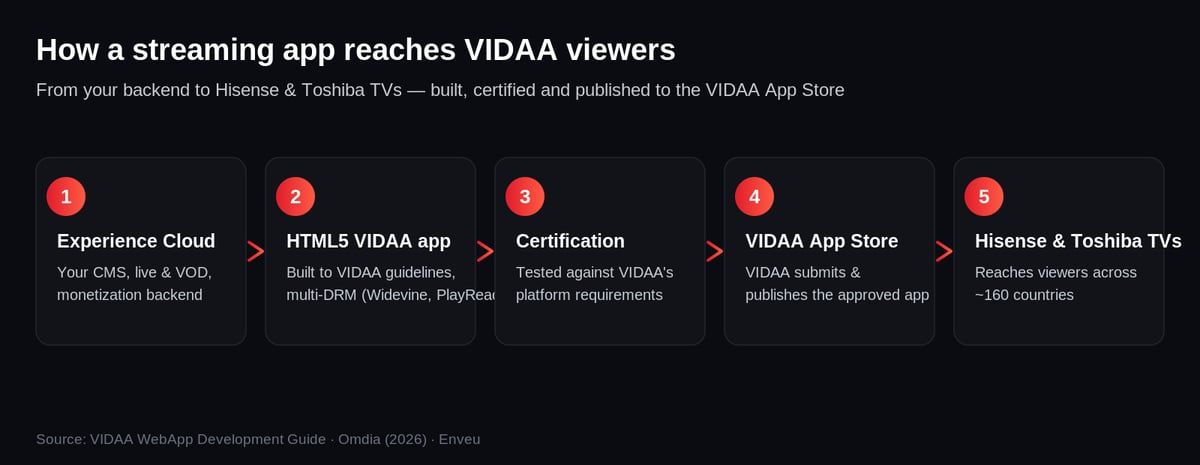
To publish, you need a VIDAA Developer Account, an app that meets VIDAA's technical and design guidelines, and content protection in place. VIDAA itself performs the final submission and publishes the app once it passes review. In practice, the steps look like this:
| Requirement | What it means |
|---|---|
| VIDAA Developer Account | Mandatory to build, test and submit an app to the platform. |
| HTML5 app + secure origin | App built to VIDAA's web-app guidelines, served over HTTPS. |
| Multi-DRM | Widevine and PlayReady are integrated across VIDAA devices for premium content. |
| Certification & review | The app is tested against VIDAA's requirements before it can go live. |
| Store submission | VIDAA handles final submission and publishes the approved app. |
How is content protected on VIDAA?
For any paid or premium catalogue, digital rights management is non-negotiable, and VIDAA supports it natively. Google Widevine (Modular) and Microsoft PlayReady are both integrated across VIDAA devices, so you can deliver studio-grade protected content with encrypted, adaptive-bitrate streaming. Apps must run from a secure HTTPS origin, and premium titles are typically served with hardware-backed DRM on certified panels. This is the same multi-DRM posture you would expect on Tizen or webOS, which is why a well-built VIDAA app can carry the same content rights as the rest of your device lineup.
Can you build your own app for VIDAA OS?
Yes — but it is a real engineering commitment, not a weekend project. You are building and maintaining an HTML5 app to VIDAA's guidelines, wiring in Widevine/PlayReady DRM, handling a remote-first UI, passing certification, and then keeping the app current as VIDAA updates its OS, web engine and store requirements. Multiply that by every other platform — Roku, Fire TV, Apple TV, Android TV and webOS — and it becomes a permanent platform team.
That is why most content owners don't build per-platform apps in-house. A managed OTT platform gives you one backend and branded apps across every screen, including VIDAA, without staffing a developer team for each OS. Enveu builds a genuinely native VIDAA app for Hisense and Toshiba TVs, handles store certification and submission, and keeps it updated over the air — all driven from the same apps backend that powers your other device apps — typically live in 4–6 weeks.
Where VIDAA fits in your device strategy
The mistake operators make is treating the TV OS market as "Samsung, LG and everything else." With VIDAA now the number-two platform by shipments and climbing, "everything else" is where a large and growing slice of your audience actually watches — especially in Europe, the Middle East and emerging markets where Hisense and Toshiba sell hard. Adding VIDAA alongside your streaming-stick and smart-TV apps closes a real coverage gap, and because it is still an emerging search term, it is a cheaper audience to reach today than it will be in two years.
If you are mapping which devices to support, our overview of OTT devices and OTT TV boxes puts VIDAA in context alongside the rest of the ecosystem — and the smart-TV apps glossary entry covers the shared build model across Tizen, webOS and VIDAA.
VIDAA OS started life as an unremarkable house operating system on budget TVs. It is now a top-two global platform that any serious streaming service should treat as a first-class target — curated, DRM-ready, and reaching hundreds of millions of screens across Hisense, Toshiba and beyond.