If you've searched "Apple TV" and come away more confused than when you started, you're not alone. Apple gives two very different products almost the same name: Apple TV (a hardware device — and an app) and Apple TV+ (a paid streaming service). This guide breaks down exactly what each one is, what they cost in 2026, how they differ, and which you actually need.
Apple TV is Apple's streaming device — a box you plug into your TV — and also the name of the Apple TV app; Apple TV+ is Apple's subscription streaming service, like Netflix, built around Apple Originals. The device is a one-time purchase; Apple TV+ is a monthly or yearly fee. And you don't need an Apple TV device to watch Apple TV+ — the app is on almost everything.
Apple TV vs Apple TV+ at a glance
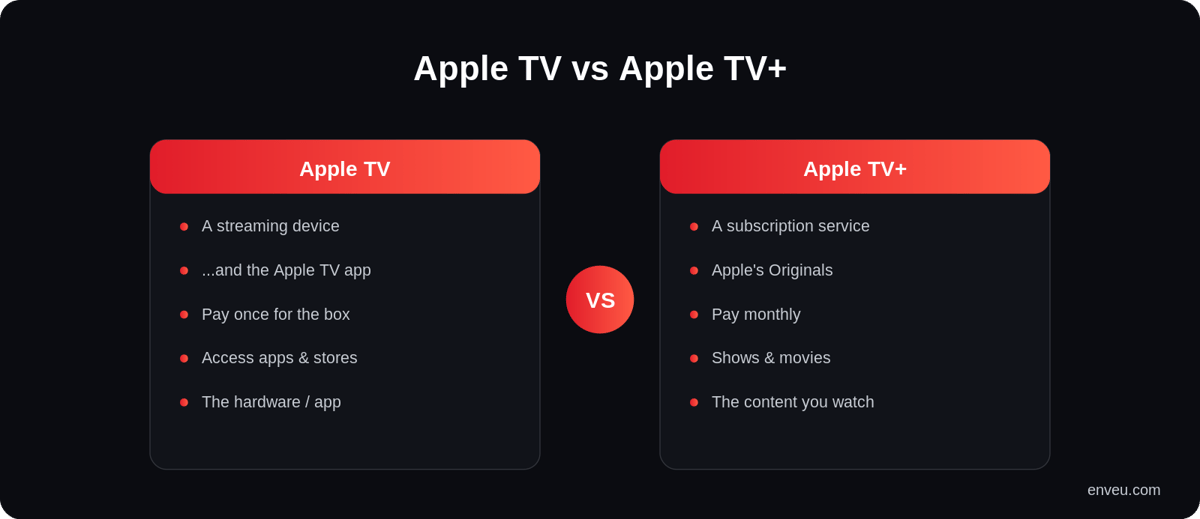
| Apple TV | Apple TV+ | |
|---|---|---|
| What it is | A streaming device (hardware) — and the Apple TV app | A subscription streaming service (content) |
| You pay | Once, for the device (the app is free) | Monthly or yearly |
| What you get | A box/app to run streaming apps, Arcade & the App Store | Apple Originals — shows and films, ad-free |
| Content source | Every app you install (Netflix, Disney+, etc.) | Apple-produced titles only (no third-party licensing) |
| Do you need it? | Optional — one of many ways to stream | Only if you want Apple's Originals |
What is Apple TV? (the device and the app)
"Apple TV" means two things, which is where the confusion begins. First, it's Apple's streaming device — a set-top box that connects to your TV over HDMI, joins your Wi-Fi, and runs streaming apps, Apple Arcade games, and the App Store, all navigated with the Siri Remote. It centralizes the big services (Netflix, Disney+, Prime Video, YouTube) in one place and supports 4K HDR and Dolby Vision on the current model. Second, "Apple TV" is also the name of the Apple TV app — the free application, pre-installed on iPhones, iPads, Macs and many smart TVs, where you browse and play content (including Apple TV+). So Apple TV is hardware and an app — but never a subscription.
Apple TV device models and 2026 prices
| Model | Price (2026) | Best for |
|---|---|---|
| Apple TV 4K (64GB, Wi-Fi) | ~$199 | 4K HDR / Dolby Vision home theatre |
| Apple TV 4K (128GB, Wi-Fi + Ethernet) | ~$249 | Wired reliability, Thread smart-home hub, more storage |
Note: Apple raised Apple TV 4K pricing in June 2026 (previously ~$129/$149), so older guides quoting the lower prices are out of date. The Apple TV HD (1080p) has been discontinued.
What is Apple TV+? (the streaming service)
Apple TV+ (with the plus) is Apple's subscription streaming service — think Netflix or Disney+, but built entirely around Apple Originals. Unlike most rivals, Apple TV+ doesn't license third-party catalogues; every title (Ted Lasso, Severance, and the rest) is produced or co-produced by Apple, and every plan is ad-free. It runs as a pure OTT service inside the Apple TV app, with no cable subscription required.
Apple TV+ pricing in 2026
- Monthly: ~$12.99/month (US)
- Annual: ~$99.99/year (works out cheaper — roughly $8.33/month)
- Free trial: typically 7 days for new subscribers
- Bundled in Apple One: alongside Apple Music, Arcade and iCloud+
Apple raised the monthly price to $12.99 (from $9.99), so — as with the device — older articles quoting $9.99 are outdated. Always check Apple's current pricing before subscribing.
Is Apple TV an OTT platform?
Both parts of "Apple TV" are OTT. Apple TV+ is an OTT service — content delivered over the top of the internet, bypassing cable. The Apple TV device is an OTT device — hardware whose job is to run OTT apps. So yes: Apple TV is OTT on both counts, the same way a OTT TV box and a streaming service are two sides of the same ecosystem.
Do you need an Apple TV to watch Apple TV+?
No. The Apple TV app — and therefore Apple TV+ — runs on iPhones, iPads, Macs, most smart TVs (Samsung, LG, Sony), streaming devices like Fire TV and Roku, game consoles, and the web. The Apple TV device is just one of many ways to watch; it is not required for the service. This is the single biggest source of confusion — and the answer is simply that the content and the hardware are separate products.
How media companies get their content onto Apple TV
There are two routes for a content owner. You can publish your own branded app to the Apple TV device (via the App Store / tvOS), so your service appears alongside Netflix and Disney+ on the living-room screen. Or your titles can surface inside Apple's TV app through Apple's content partnerships. For most operators, the first route — your own app — is what matters, because it keeps your brand, your subscribers and your data.
Building a tvOS app natively is slow and specialist, and it's only one of the many screens your audience uses. Enveu's apps ship your branded streaming service to Apple TV plus Fire TV, Roku, Android TV, mobile and web — 15+ platforms from one back end, with content managed in the Content Manager and SVOD, AVOD, TVOD and hybrid monetization built in. So, like Apple, your service reaches viewers on whatever device they own — not just one. It's part of Experience Cloud.
The bottom line
Apple TV is the hardware and the app; Apple TV+ is the content subscription. Buy the device if you want a fast, polished box for the living room; subscribe to Apple TV+ if you want Apple's Originals — and you can do either without the other. The naming is confusing; the products aren't.