Cloud video streaming means hosting, encoding, and delivering video entirely from the cloud instead of your own servers — you upload content and the platform handles transcoding to adaptive bitrate, storage, global delivery and playback at scale. It removes the need to buy and run encoding hardware or manage infrastructure, so you can launch and grow a streaming service faster. The main choice is which type of cloud platform fits: an enterprise OTT platform, a hosting service, or a DIY cloud stack.
What is cloud video streaming?
Cloud video streaming is the delivery of on-demand or live video where all the heavy lifting — encoding, transcoding, storage and delivery — happens on cloud infrastructure rather than on-premise servers. You upload (or send a live feed), and the cloud platform prepares the video for every device and connection automatically. It's what lets a small team run a service that would once have needed a data centre.
Is cloud video streaming secure?
It can be very secure — often more so than a homemade setup. Cloud platforms protect content with studio-grade DRM (Widevine, PlayReady, FairPlay), encrypt streams in transit, and add token authentication, geo-blocking and forensic watermarking to deter piracy. On the account side, cloud providers offer redundancy and enterprise security certifications most operators couldn't build alone. The practical takeaway: security is a reason to use a reputable cloud platform, not to avoid one — provided you choose one with proper DRM and access controls for the content you carry.
Cloud video streaming vs cloud gaming
Quick clarification, because "cloud streaming" gets used two ways. This guide is about cloud video streaming — delivering movies, shows, live events and on-demand video from the cloud. The other meaning is cloud gaming (Xbox Cloud Gaming, GeForce NOW), where a game runs on a remote server and the video output is streamed to your screen. Both stream from the cloud, but the infrastructure and goals differ; everything below is about video.
How cloud video streaming works
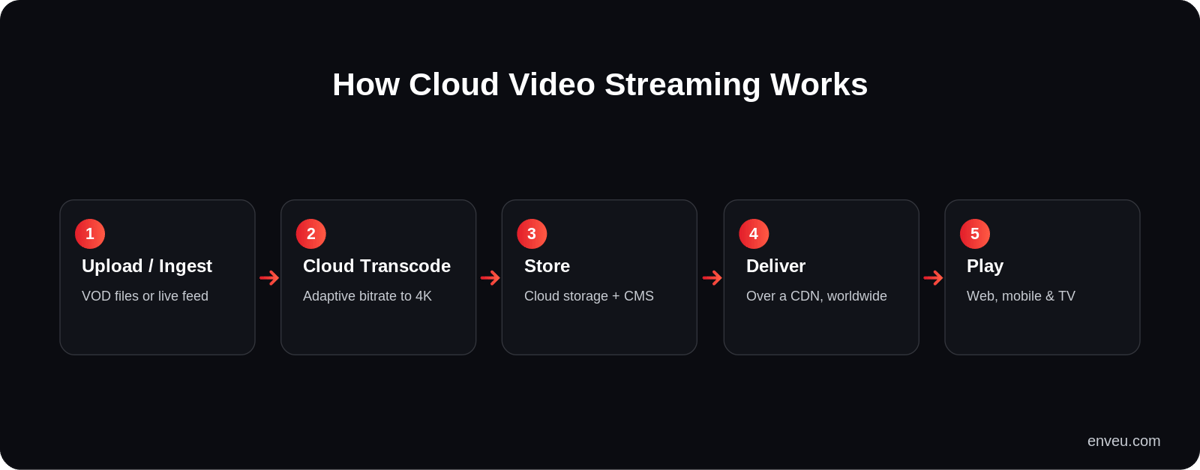
- Upload or ingest — send VOD files or a live stream to the cloud.
- Cloud transcode/encode — the platform converts it into multiple adaptive-bitrate renditions (up to 4K).
- Store — content and metadata live in cloud storage and a CMS.
- Deliver — streams go out over a CDN to viewers worldwide.
- Play — adaptive playback on web, mobile and TV apps.
Cloud vs on-premise streaming
| Cloud video streaming | On-premise / self-hosted | |
|---|---|---|
| Setup | Minutes — no hardware | Buy, rack and configure servers |
| Scaling | Elastic, on demand | Capacity-planned, capped |
| Encoding | Cloud transcoding included | Your own encoders to run and maintain |
| Cost shape | Operating subscription/usage | Large upfront + maintenance |
| Best for | Launching & growing services fast | Niche, fully controlled environments |
Benefits of cloud video streaming
- No hardware to buy or run — the provider owns the servers, encoders and CDN; you just upload and publish.
- Elastic scale — handle 1,000 or 10 million concurrent viewers without capacity planning.
- Faster time to market — launch a service in weeks instead of standing up a data centre.
- Lower, predictable cost — pay-as-you-go usage instead of large upfront capital and idle capacity.
- Global reach — deliver worldwide from day one over an integrated CDN.
- Reliability & updates — built-in redundancy and automatic updates, without an in-house ops team.
Types of cloud video streaming platform
- Enterprise OTT platform — a full streaming business in the cloud: CMS, transcoding, DRM, monetization and branded apps.
- Cloud video hosting — simpler embedding of secure video on a website.
- DIY cloud stack — assembling cloud encoding, storage and CDN yourself (maximum control, maximum effort).
Common use cases for cloud video streaming
- OTT / DTC services — branded subscription or ad-supported streaming apps (a Netflix-style service).
- Live events & sports — scaling to huge concurrent audiences for a match, concert or conference.
- Education & training — secure course libraries and live classes for schools and enterprises.
- Enterprise communications — town halls, internal broadcasts and webinars.
- Fitness, faith & audio — on-demand classes, services, and music/podcast streaming.
Challenges of cloud video streaming (and how they're solved)
- Bandwidth in emerging markets — solved with adaptive bitrate that drops quality gracefully instead of buffering.
- Latency for live — reduced with low-latency protocols and edge delivery close to viewers.
- Vendor lock-in — mitigated by choosing platforms with open APIs and standard formats (HLS/DASH).
- Security & piracy — handled with DRM, encryption, token authentication and watermarking.
- Cost at scale — managed with efficient codecs (HEVC/AV1) and smart CDN/caching.
What to look for in a cloud video streaming platform
- Scalability & performance — handles traffic surges during live events and popular releases.
- Adaptive bitrate — smooth playback across devices and connection speeds.
- Security & DRM — encryption, token auth and studio-grade DRM for premium content.
- Monetization — native SVOD, AVOD, TVOD, PPV and hybrid.
- Multi-device apps — web, mobile and TV from one back end.
- Analytics & APIs — real-time insight and integrations with your existing stack.
How to launch a cloud video streaming service
- Bring your content — upload a VOD catalog or connect a live source to the cloud.
- Let it transcode — the platform builds the adaptive-bitrate ladder automatically.
- Set monetization — SVOD, AVOD, TVOD, PPV or hybrid.
- Publish branded apps — web, mobile and TV from one back end.
- Go live and optimize — use analytics to improve engagement and retention.
Because the infrastructure is cloud-managed, most operators go from signup to launch in weeks rather than months. This same shift underpins cloud TV, where live channels and playout also run entirely in the cloud.
Choosing a cloud video streaming platform
If your goal is to launch a branded service — a catalog, subscribers and apps on every screen, whether a fitness streaming platform or an entertainment library — an enterprise OTT platform is the fit, because encoding, delivery, DRM and monetization come as one cloud system. Enveu's Experience Cloud does exactly that: cloud transcoding to adaptive bitrate up to 4K in the Content Manager, integrated CDN delivery, DRM, and SVOD/AVOD/TVOD/hybrid monetization on your own apps. Having launched 50+ OTT platforms, we run this in the cloud so you don't run infrastructure. Compare delivery options in our video CDN guide or platform types in online video platforms.