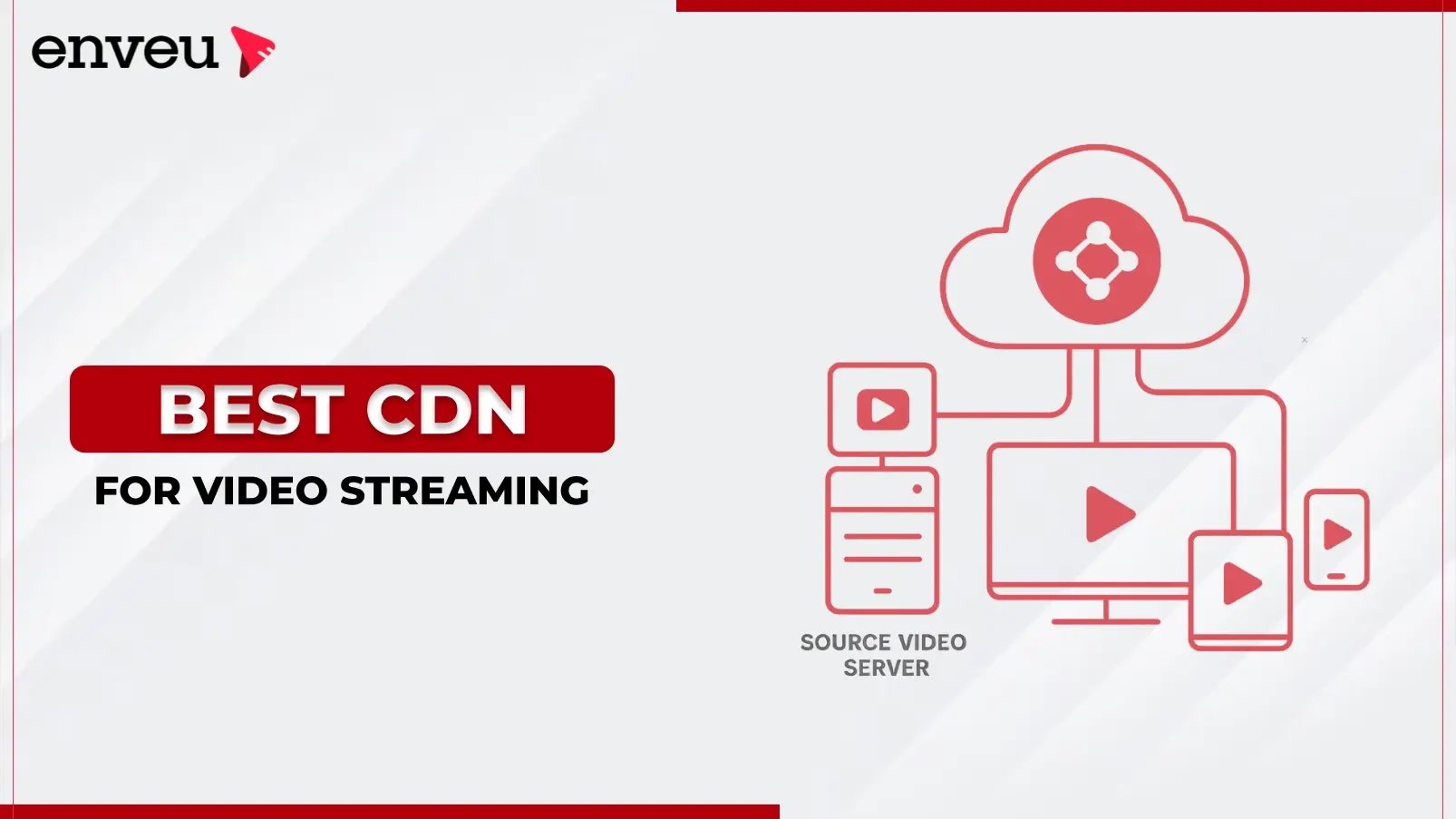
A video CDN (content delivery network) is a global network of edge servers that caches your video close to viewers, so streams start fast and don't buffer. The best video CDNs for streaming include Akamai, Amazon CloudFront, Cloudflare, Fastly, Google Cloud CDN and Bunny — the right choice depends on your scale, whether you run live or on-demand, and budget. Many streaming platforms include delivery, so you never have to pick or manage a CDN yourself.
What is a video CDN?
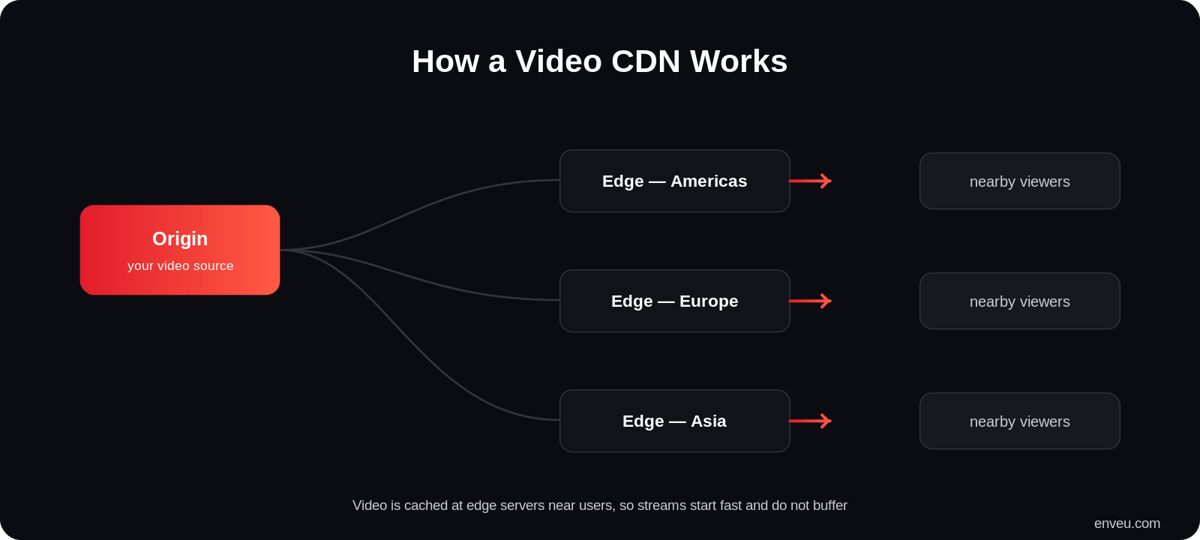
A video CDN is a distributed network of servers placed around the world. Instead of every viewer pulling video from your single origin server, the CDN caches copies at edge locations near users and serves the stream from the closest one. That cuts latency and buffering, absorbs traffic spikes, and is essential for delivering adaptive-bitrate video at scale — usually over TCP-based HTTP. When that content needs protecting in transit, it's often delivered as encrypted HLSe.
How a video CDN works
CDN vs traditional hosting
With traditional hosting, every viewer pulls video from one origin server — so distant users get slow, buffering playback and a traffic spike can overwhelm the source. A CDN caches your content at edge servers worldwide and serves each viewer from the nearest one, so performance stays fast and consistent no matter where the audience is or how many show up at once. For video at any real scale, a CDN isn't optional.
Why a CDN matters for video streaming
- Lower bandwidth cost — caching at the edge offloads traffic from your origin and reduces egress.
- Low latency — serving from a nearby edge means faster start times and less buffering.
- Scalability — absorbs sudden audience spikes (a live final, a viral release) without crashing your origin.
- Security — token authentication, HTTPS, geo-blocking and DDoS protection at the edge.
- Consistent quality — reliable adaptive-bitrate delivery so viewers hold the highest quality their connection allows.
Best video CDN providers for streaming
| CDN | Known for |
|---|---|
| Akamai | The largest, most established network; enterprise scale and media delivery. |
| CDNetworks | Strong coverage in Asia; good for global reach into APAC markets. |
| Amazon CloudFront | Deep AWS integration; convenient if your stack is already on AWS. |
| Cloudflare | Huge global footprint, strong security/DDoS, developer-friendly. |
| Fastly | Real-time, low-latency delivery with fine-grained edge control. |
| Google Cloud CDN | Google's edge network; integrates with Google Cloud. |
| Bunny.net | Cost-effective, easy to set up; popular with smaller streamers. |
| KeyCDN | Simple, pay-as-you-go pricing; a lightweight option for smaller sites. |
| Microsoft Azure CDN | Integrates with the Azure cloud stack; enterprise reach. |
There's no single "best" CDN — it depends on your priorities. Global media at massive scale points to Akamai; existing cloud stacks favour CloudFront or Google Cloud CDN; security and reach favour Cloudflare; ultra-low latency favours Fastly; and tight budgets favour Bunny.
What to look for in a video CDN
- Live vs on-demand — live streaming needs low latency and reliable origin shielding; VOD prioritizes cache efficiency.
- Global coverage — edge presence where your audience actually is.
- Adaptive bitrate support — clean HLS/DASH delivery and fast segment serving.
- Security — token authentication, geo-blocking, HTTPS and DDoS protection.
- Cost model — per-GB egress adds up fast at streaming scale; model it against your traffic.
CDN for live streaming
Live is the hardest case: you need consistent low latency and the network has to hold up when a stream spikes. A good live CDN combines wide edge coverage with origin shielding so a sudden audience doesn't overwhelm your source. If you're comparing options specifically for live, weight latency and reliability over raw price.
CDN vs a full streaming platform
A CDN only handles delivery. It doesn't transcode your video, manage your catalog, protect it with DRM or monetize it — you'd assemble those separately. A full streaming platform bundles the CDN into an end-to-end system (ingest, transcode, DRM, apps, monetization), which is why most operators use a platform rather than wiring a standalone CDN into a homemade stack.
Key CDN terms to know
- Origin — your source server where the master copy of the video lives.
- Edge server — the CDN node near the viewer that serves the cached copy.
- Cache / TTL — how content is stored at the edge and how long before it's refreshed.
- Origin shielding — an intermediate cache layer that protects your origin from spikes.
- Egress — data delivered out to viewers, the metric most CDNs bill on.
How CDN pricing works
Most video CDNs charge for egress — the data delivered to viewers, priced per gigabyte, usually on a regional tier (delivery into Asia or South America often costs more than North America or Europe). Some add request fees or charge for premium features like origin shielding and advanced security. Because streaming moves enormous amounts of data, egress is the line item that dominates the bill — a single hour of 1080p is gigabytes per viewer, so model your cost against realistic concurrent-viewer numbers, not averages.
How to choose a video CDN
- Map your audience — pick a CDN with strong edge presence where your viewers actually are.
- Match live vs VOD — weight low latency and origin shielding for live; cache efficiency for VOD.
- Check ABR + format support — clean HLS/DASH delivery and fast segment serving.
- Model the egress cost — against realistic peak concurrency, not averages.
- Consider multi-CDN — larger services use two or more CDNs and switch based on performance and cost.
What is a multi-CDN strategy?
Big streaming platforms rarely rely on a single CDN. A multi-CDN setup routes each viewer to the best-performing (or cheapest) network in real time, adds redundancy if one CDN degrades, and improves coverage in regions where one provider is weak. It's more complex to run — which is another reason many operators let their streaming platform handle delivery rather than managing CDNs directly.
Do you need to choose a CDN yourself?
Often, no. For most operators, wiring up, tuning and paying a separate CDN is overhead you don't need. Enveu delivers your content through integrated CDN delivery with leading providers and partners — transcoding to adaptive bitrate up to 4K in the Content Manager and delivering it globally across every device — so you get fast, resilient streaming without selecting or managing a CDN. For live specifically, see live streaming platform; for the broader picture, cloud video streaming platforms. What the CDN actually delivers is described by the stream's manifest file.