Monetize video in 12+ ways
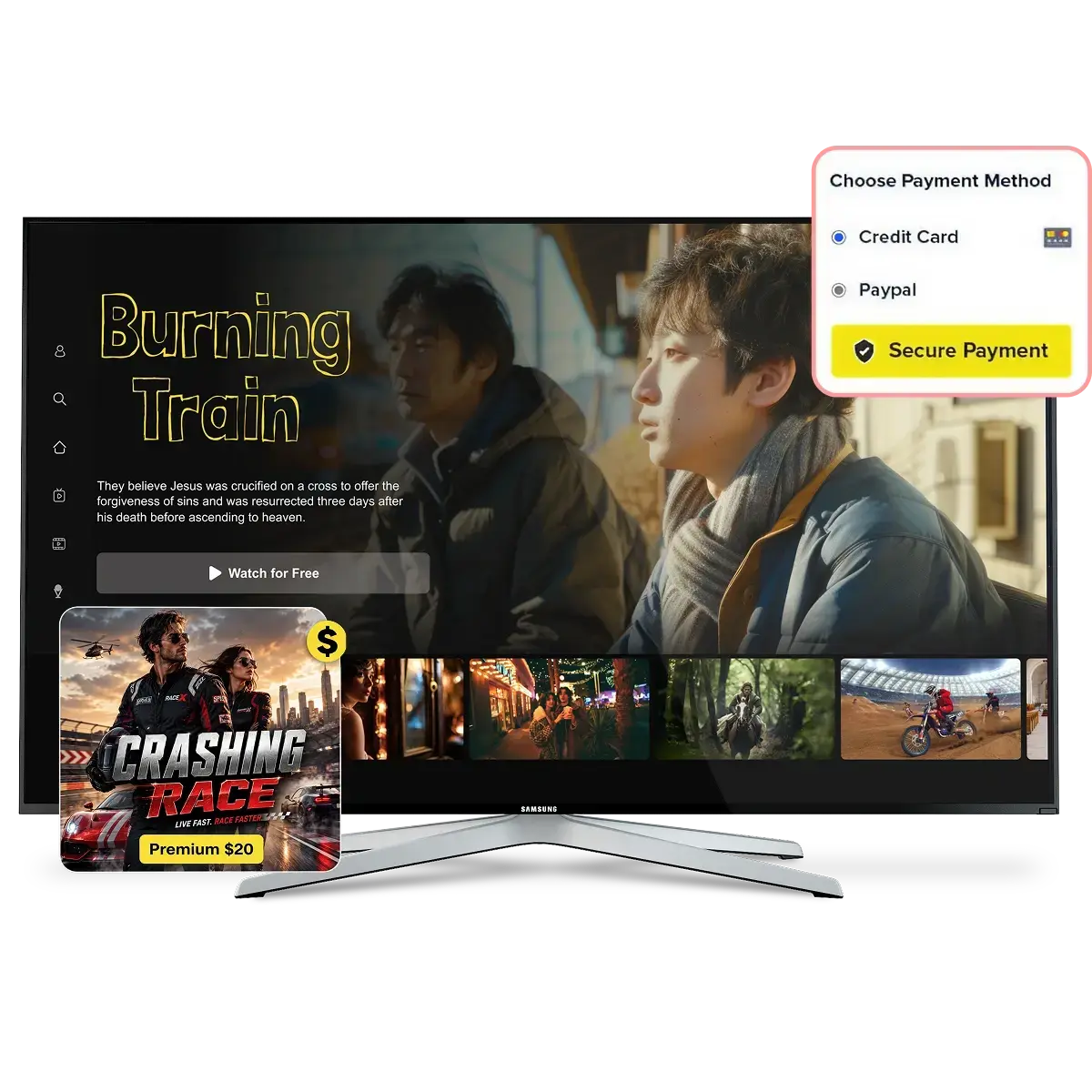
A video monetization platform turns viewing into revenue. Enveu supports SVOD (subscriptions), AVOD (ads), TVOD (rent or buy), PPV and hybrid models together, with global payments, server-side ad insertion and revenue analytics — and takes 0% of what you earn.






A video monetization platform is the billing and revenue engine behind a streaming service: it decides who can watch what, charges them for it, and tells you what worked. That covers subscriptions, ad insertion, rentals, one-off purchases, and the paywall logic that ties them together.
Most platforms make you pick one model. Enveu lets you run several at once — a subscription tier, an ad-supported free tier, and pay-per-view for premium events — and switch between them without a rebuild. It is powered by Subscriber Management inside Experience Cloud.
The number that matters most when comparing video monetization platforms is not the monthly fee — it is the revenue share. A 10% cut on a service earning £500k a year is £50k annually, every year, growing as you grow. That is usually far more than the licence it replaces. Model both against your own projected subscribers before you choose; our revenue calculator will do it in a couple of minutes.
Every way to make money from video
Subscriptions (SVOD)
Recurring plans — monthly, quarterly and annual, with free trials and coupons.
Advertising (AVOD)
Server-side ad insertion, VAST/VMAP, pre/mid/post-roll and ad podding.
Transactional & PPV
Rent, buy or sell access to a single title or a live event.
Payments processing
Cards, wallets, in-app purchase and carrier billing — multi-currency and geo-priced.
Security & compliance
DRM, IAM, PCI DSS and GDPR compliance built in.
Revenue analytics
ARPU, churn, LTV and cohort dashboards in real time.
Video monetization at a glance
How to monetize video with Enveu
SVOD, AVOD, TVOD, PPV or hybrid — run them together or switch freely.
Cards, wallets, in-app purchase and carrier billing, in every currency you sell in.
Server-side ad insertion with VAST/VMAP through your existing ad server.
Track ARPU and churn, run win-back offers — and keep 100% of it.
Video Monetization, module by module
Every capability above maps to a product you can see in a demo — not a feature list.
Plans, paywalls, payments and churn control across SVOD, TVOD, AVOD and PPV.
Explore Subscriber Management →The video CMS: ingest, metadata, captions, transcoding, scheduling and DRM packaging.
Explore Content Manager →Branded apps for web, mobile, Apple TV, Fire TV, Roku and smart TVs — 15+ platforms from one codebase.
Explore Apps →Users, roles, granular permissions and audit logs across your platform.
Explore Access Center →Experience Cloud + Enveu Flow
Launch and run it with Experience Cloud, automate the media work with Enveu Flow — use one, or both together.
- Subscriptions, ads, rentals and PPV from one paywall
- Global payments and multi-currency pricing
- Real-time ARPU, churn and LTV dashboards
- No revenue share — the licence is the only cost
- Auto-cut promos and trailers that drive signups
- Repurpose long video into social clips
- Publish faster, so there is more to monetize
Video monetization by industry
Sports →
Live matches, replays and highlights.
Entertainment →
Series, films and originals.
Education →
Courses, live classes and cohorts.
Fitness →
Live and on-demand classes.
Religious →
Live services, teachings and archives.
Creators →
Fan memberships and pay-per-view.
Kids →
Safe, age-appropriate streaming.
Audio →
Podcasts, music and audio.
I wanted to create a platform that can accommodate more producers to publish and monetise their content easily; we take only a small cut, and they retain their rights.
 Tony SaabFounder & CEO, Tesliya
A huge shoutout to team Enveu for helping us with our every need and making our vision a reality.
 Alexandru MorarasDirector, Iberalia GO
Why teams choose Enveu for video monetization
0% revenue share
A 10% cut on £500k a year is £50k — every year, growing as you grow. Enveu takes none of it.
Run models side by side
A free ad-supported tier and a paid subscription from the same paywall, not two systems stitched together.
Paid globally, priced locally
Cards, wallets, UPI, in-app purchase and carrier billing, with per-market pricing.
Free, revenue-share, or flat licence
The headline price is rarely the real cost. What matters is what you keep.
| Free / ad-funded platform | Revenue-share SaaS | Enveu | |
|---|---|---|---|
| Upfront cost | £0 | Low | Platform licence |
| What they take | A cut of ad revenue, plus your audience data | A % of everything you earn — permanently | 0% |
| Who owns the viewer | The platform | Shared, in practice | You |
| Models available | Ads, mostly | Usually one or two | SVOD, AVOD, TVOD, PPV, hybrid — together |
| Payments | Theirs | Theirs | Your gateways, your currencies, your pricing |
| Best when | You are starting out and want reach | Revenue is small and staying small | Revenue is real and growing |
On a service earning £100k a year, a 10% revenue share costs £10k — likely less than a licence, and the free tier is genuinely the right choice while you are small. The maths inverts as you grow: at £1m it costs £100k a year, every year, and rises forever.
Go deeper on monetization
Transactional VOD — pay-per-title, and how it compares to SVOD and AVOD.
Read the definition →Build vs. buy, native vs. hybrid, single vs. multi-CDN — the trade-offs, side by side.
Compare approaches →Model monthly and annual revenue across SVOD, AVOD and TVOD from your own numbers.
Model your revenue →How media companies launched and scaled on Enveu — and what it cost them.
Read the stories →Integrations that power this
Enveu connects the payment, video, DRM, and analytics tools your stack already uses — no rebuild required.
Monetize your video with Enveu.
Book a walkthrough and model the revenue against your own catalogue.