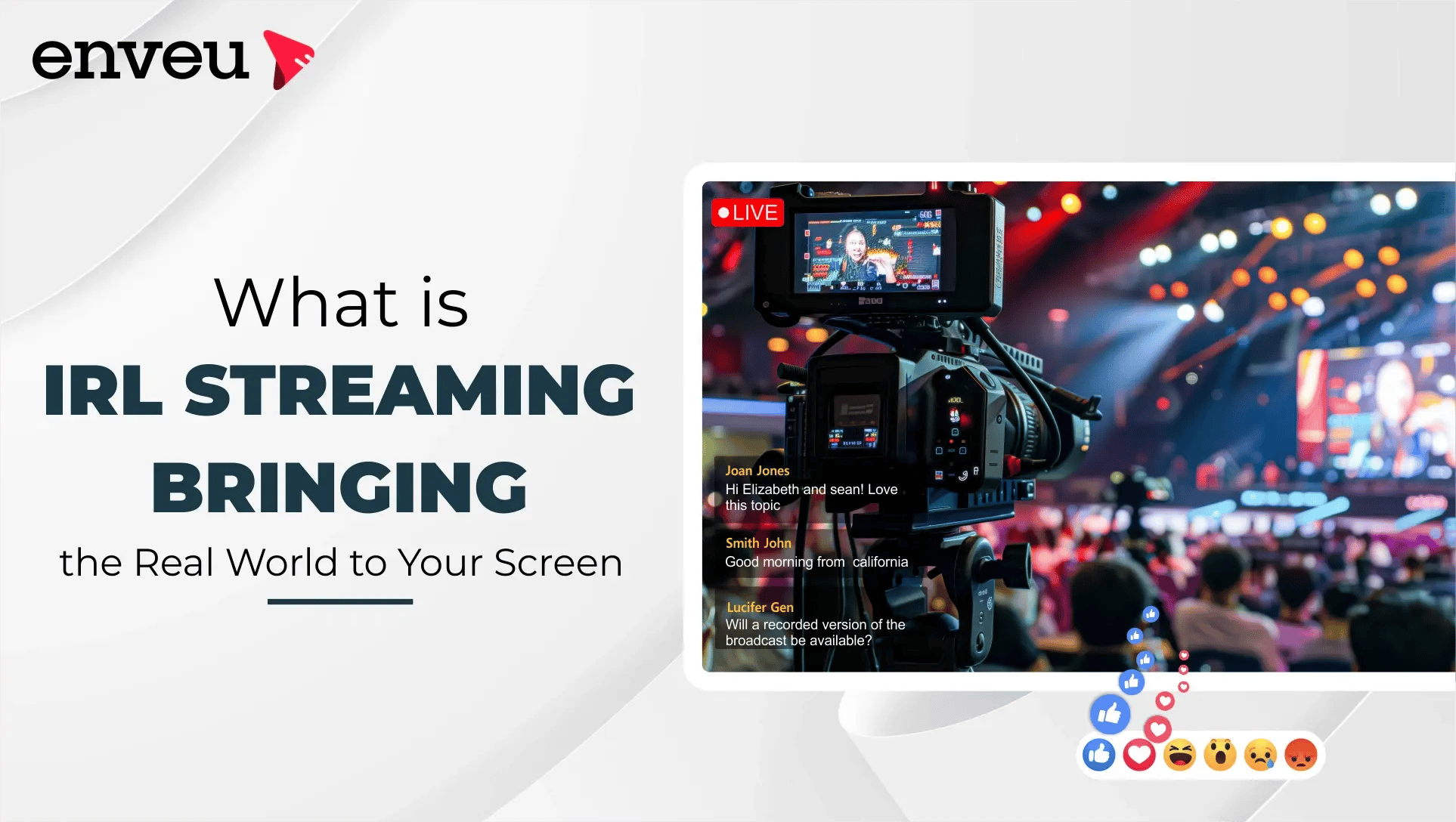
IRL streaming means "in real life" streaming — broadcasting live from the real world outside a studio or gaming setup, as the streamer moves around: walking, travelling, eating, attending events or just chatting. "IRL" is the full form of "in real life," and IRL streaming is the mobile, on-the-go style of live content. It relies on a phone or camera, a portable internet connection (usually bonded cellular or 5G) and a streaming platform, so the creator can broadcast live from anywhere.
What does IRL mean?
IRL stands for "in real life." Online, it distinguishes the physical world from digital, virtual or gaming activity — "let's meet IRL" means in person, not online. The term started in chat and gaming communities and spread everywhere. In streaming it took on a specific second meaning: a whole category of live content shot in the real world rather than from a webcam-and-game setup. Delivering it to an audience needs a live platform; see the best Livestream alternatives.
IRL full form and meaning
The full form of IRL is "In Real Life." So "IRL stream" literally means an "in real life stream" — a live broadcast of the streamer's actual surroundings and activities. When people search "IRL streaming meaning," this is it: not a game feed or a static talking-head, but the creator out in the world, camera rolling, interacting with their environment and their live chat at the same time.
What is IRL streaming?
IRL streaming is live, on-the-move broadcasting from the real world. A creator streams themselves walking a city, travelling, cooking, at an event, or simply "just chatting" — usually from a phone or a portable camera rig, over a mobile connection. It exploded on platforms like Twitch, YouTube and Kick, and it's become one of the most engaging live formats precisely because it feels spontaneous and unscripted: anything can happen, and the audience is along for the ride in real time.
How does IRL streaming work?
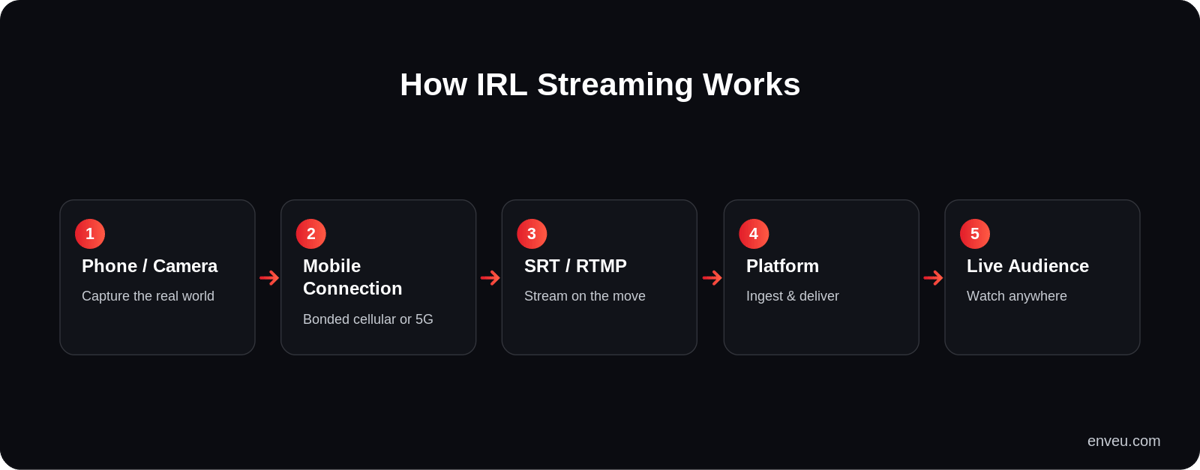
- Capture — a phone or camera films the streamer and their surroundings.
- Connect — the feed goes out over a mobile connection, often bonded cellular (several SIMs combined) or 5G for reliability on the move.
- Encode & send — an app or a portable encoder compresses the video and pushes it to the platform via RTMP or SRT — protocols built on TCP and UDP.
- Deliver — the platform ingests the stream and delivers it live to viewers, who watch and chat in real time.
The whole rig has to be portable and battery-powered, which is the core technical challenge that separates IRL from studio streaming.
Common types of IRL streaming
- Just chatting — talking directly to the audience, no game or fixed set.
- Travel & walking streams — exploring places live on the move.
- Events & experiences — concerts, meetups, food tours, day-in-the-life.
- Outdoor / adventure — hiking, driving, sports; see our guide to outdoor live streaming.
IRL streaming vs studio and gaming streams
| IRL streaming | Studio / gaming stream | |
|---|---|---|
| Where | Out in the real world, on the move | Fixed setup (desk, webcam, game) |
| Connection | Mobile — bonded cellular / 5G | Fixed home broadband |
| Feel | Spontaneous, unscripted | Controlled, repeatable |
| Main challenge | Staying online while moving | Content/production quality |
What you need for IRL streaming
Because you're away from fixed broadband, IRL streaming is built around mobile connectivity. The challenge is keeping the stream stable while moving through areas of weak signal — which is why serious IRL streamers use bonded-cellular backpacks that combine several networks.
| What you need | Why |
|---|---|
| Phone or camera | Your video source — a phone is enough to start; a camera rig gives more control. |
| Bonded cellular / 5G | Combines networks so the stream survives weak signal on the move. |
| Resilient protocol (SRT/RTMP) | SRT recovers dropped packets on unstable networks; RTMP is universal. |
| Power | Batteries/power banks — you won't have a wall socket. |
| Streaming platform | Ingests the feed and delivers it live to your audience. |
For the gear side, see outdoor streaming and encoders.
Where is IRL streaming popular?
IRL streaming took off on Twitch, whose "IRL" and "Just Chatting" categories are among its most-watched, and it's now huge on YouTube Live and Kick too. These platforms give IRL creators a built-in live audience, chat and discovery, which is why most start there. The format spans everything from a creator walking through a night market to full-time travel streamers broadcasting across countries. Wherever there's a live audience that wants unscripted, real-world content, IRL streaming has a home — and because it only needs a phone and a connection, new creators can jump in without a studio.
IRL streaming ideas and examples
- City & travel walks — explore a neighbourhood, market or landmark live, chatting with viewers as you go.
- Food & restaurant streams — try dishes and react in real time; a perennial IRL favourite.
- Events & meetups — concerts, conventions, sports, festivals (subject to venue rules).
- Day-in-the-life — errands, work, routines; low-effort, high-relatability content.
- Outdoor & adventure — hikes, drives, camping; see outdoor live streaming.
- Skills & how-to on location — cooking, fixing, building, filmed live where it happens.
The common thread is authenticity: IRL viewers tune in for the real, in-the-moment feel, not polished production. The best IRL streamers lean into that — narrating what they see, reading chat aloud, and letting the unexpected happen.
The challenges of IRL streaming
The single hardest part is connectivity: a moving streamer passes through dead zones, congested networks and buildings that kill signal, so without bonding the stream freezes or drops. Beyond that, there's battery life (long streams drain phones and rigs fast), safety and privacy (filming in public, protecting your location), and moderation (live real-world content is unpredictable). Good IRL streamers plan routes, carry spare power, and use a resilient protocol and platform so a signal dip doesn't end the broadcast.
Is IRL streaming worth it, and how do you start?
For creators who want to stand out, IRL is one of the most engaging formats there is — it builds a strong, loyal community because viewers feel like they're spending real time with you. To start, you don't need a backpack: a phone, a streaming app, a battery pack and a decent mobile plan are enough to test the format. As you grow, invest in bonding and a camera rig for reliability. The bigger strategic question is where that audience lives — and whether you own it.
How do IRL streamers make money?
IRL streaming monetizes much like other live content, but the on-the-move format opens a few extra doors. The main routes are viewer tips and donations (often the biggest earner for IRL creators, since engaged audiences reward real-time moments), subscriptions to a channel for perks, gifts and virtual currency on platforms that offer them, ads run against the stream, and brand sponsorships — a travel or food IRL streamer is a natural fit for location and product deals. Many creators combine several of these. The limiting factor on a big platform is that it sets the rules and takes a cut of most of them, which is why serious IRL creators increasingly look at owning their audience directly.
IRL streaming for creators and brands
The catch with streaming on a big platform is that it owns the audience and takes a cut. Creators and brands who want to own their IRL audience — and monetize it directly — increasingly run their own live apps. Enveu's live streaming platform ingests RTMP/SRT (see how real-time streaming protocols work) and delivers your live IRL streams — from fitness classes to events — across web, mobile and TV on your own branded apps, with monetization (subscriptions, ads, tips, PPV) built in. It's part of Experience Cloud.